Polyaspartic Floor Coating Nashville: Polyaspartic Floor Coating in Nashville: The Right Topcoat for Tennessee UV and Heat
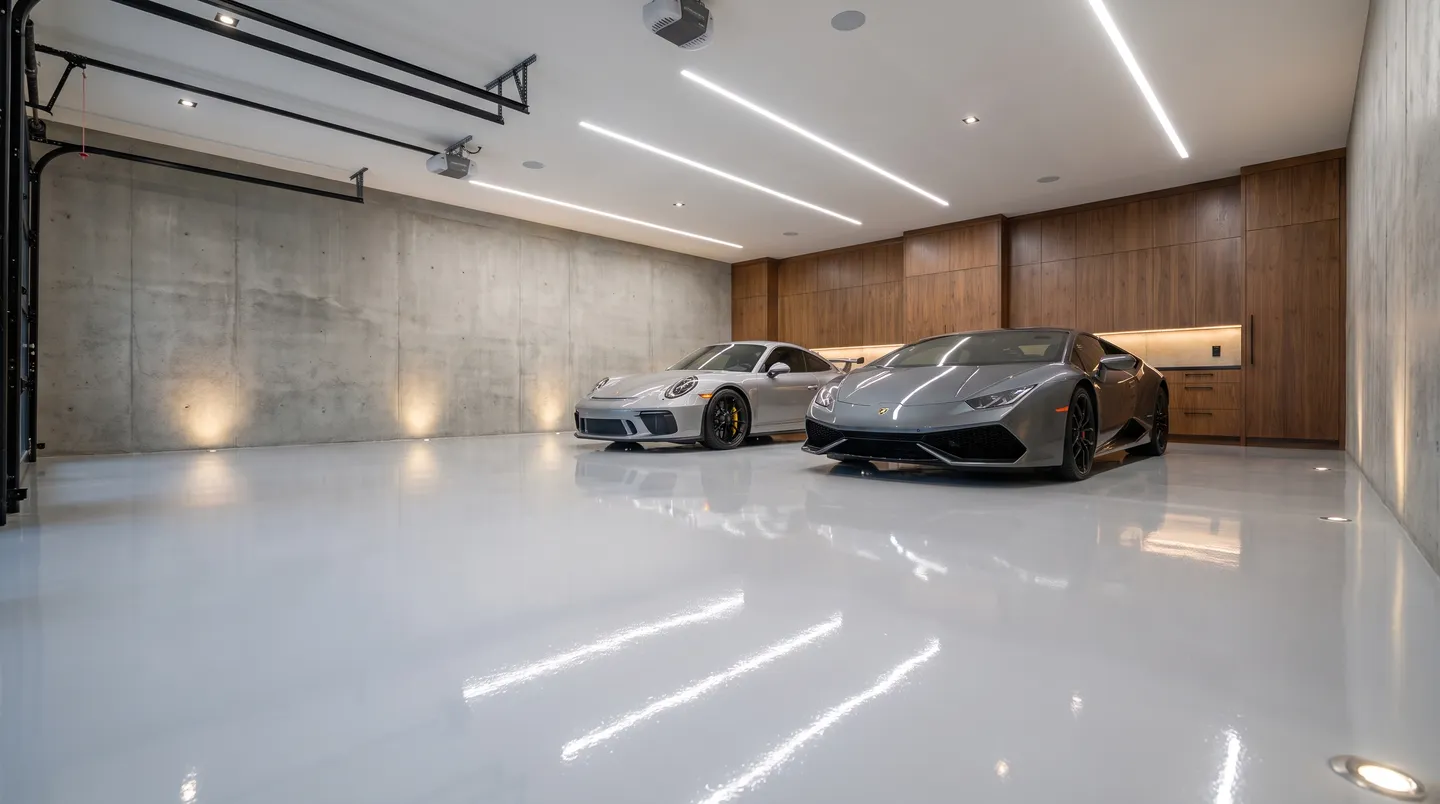
Polyaspartic floor coatings have become the dominant topcoat choice for garage and commercial floors in sun-belt markets - and for good reason. Nashville's high UV index and extreme summer temperatures create conditions that cause standard epoxy topcoats to yellow, chalk, and lose gloss within two or three seasons. Polyaspartic's aliphatic chemistry is inherently UV-stable: it doesn't contain the aromatic ring structures that break down under ultraviolet light. A polyaspartic topcoat over an epoxy base coat gives you an epoxy floor's strength and chemical resistance, combined with a clear coat that holds its color and gloss through years of direct and indirect sun exposure. ProEpoxy uses 100% solids polyaspartic on every garage and retail floor where UV exposure is a factor - which in Nashville, is almost everywhere.
Polyaspartic Floor Coating Nashville: Fast Cure: Real-World Implications for Nashville Customers
Polyaspartic's cure speed is well-documented (tack-free in under 30 minutes, back to light traffic in 2–4 hours), but what this means practically for a Nashville homeowner or business owner is significant. A two-car garage can be installed and opened in a single day - diamond-grind in the morning, base coat by noon, polyaspartic topcoat by mid-afternoon, light foot traffic by evening. For businesses, it means floors done over a single overnight shift. The fast cure does require installers who know the material: polyaspartic's pot life ranges from 20–45 minutes depending on formulation and ambient temperature, and Nashville summers require a product formulated for high-heat installation (we use slow-set polyaspartic in summer to maintain workability). Amateur installers often get into trouble here - we don't.
Polyaspartic vs. Epoxy: When to Use Which
Epoxy has better adhesion, higher compressive strength, and greater chemical resistance than polyaspartic - so for commercial floors, it's always the base coat. Polyaspartic is not a replacement for epoxy; it's the finishing layer that protects the epoxy from UV and provides the clear gloss you see. For residential garages, some installers now use 100% polyaspartic for both layers (no epoxy base) - this works well if the slab is dry and well-prepared, and simplifies the installation to a single day. We assess each slab and recommend the system architecture that makes sense: epoxy-plus-polyaspartic for maximum durability, or all-polyaspartic for single-day residential projects. Either way, the topcoat spec is the same.
Pricing and What to Expect
A polyaspartic floor coating in Nashville, installed by our crew, runs $3.50–$6 per sq ft for a standard two-car garage (decorative flake system with polyaspartic topcoat). The range reflects slab condition, amount of crack repair, and whether additional penetrating moisture primer is required. Our free walkthrough takes 20–30 minutes, at the end of which we'll put a firm number in writing. No high-pressure follow-up, no commitment required. Book online or call (888) 275-7078 - most residential jobs are scheduled within 5–7 business days of quote approval.
One-Day Installation: What It Actually Means
Polyaspartic is marketed as "one-day garage floor" by franchise coating companies across Nashville. The marketing is real - polyaspartic full systems can be installed in a single day because the base coat cures fast enough to receive the topcoat in 1–2 hours rather than waiting overnight. What matters is what gets done with that day. In our standard one-day residential install, day one starts at 7 AM with diamond grinding, proceeds through crack/joint repair, base coat application, decorative flake broadcast, and clear polyaspartic topcoat, with the crew leaving by 4–5 PM. The floor reaches light foot traffic in 2 hours and vehicle traffic in 12 hours. What you don't get in a one-day system: extensive crack repair, moisture mitigation primers, or complex metallic layers - those require multiple-day schedules. When a Nashville slab has significant issues - extensive cracking, high vapor emission, oil contamination - a one-day schedule is not appropriate and we'll say so upfront rather than trying to compress a multi-day job into one.
UV Performance in Nashville's Solar Environment
The primary technical advantage of polyaspartic over standard aromatic epoxy topcoats in Nashville is UV resistance. Standard aromatic epoxy yellows at a rate of roughly 3–4 yellowness index units per year under direct UV exposure in central Tennessee. After two seasons in a south-facing or open-door garage, a clear aromatic epoxy topcoat typically shows visible amber discoloration. Aliphatic polyaspartic maintains its clarity because the aliphatic chemistry doesn't absorb UV at the wavelengths that cause aromatic ring cleavage. We use only aliphatic polyaspartic topcoats on every floor coating installation in Nashville - the $0.50–$1.00 per sq ft price difference between aliphatic and aromatic chemistry is not a meaningful cost consideration when the service life difference is 10+ years vs. 2–3 years in this UV environment.
Recoating and Maintenance of Polyaspartic Floors
Polyaspartic floors in Nashville residential garages that are well-maintained typically last 10–15 years before a topcoat refresh is warranted. The chip base coat below almost never needs replacing - only the clear topcoat shows wear. When the time comes, recoating is straightforward: light abrasion of the existing topcoat, clean and degrease, apply a new polyaspartic clear in one coat. The whole process takes 4–6 hours with a 24-hour return to vehicle traffic. Regular maintenance is minimal: damp mop with pH-neutral cleaner, keep entry mats at the garage door to catch Tennessee red clay and grit before it's tracked onto the floor, and avoid dragging metal objects. Polyaspartic has Shore D hardness of 75–85, which resists most scratches, but metal casters on workshop stools and dragged tool cabinets will eventually scratch any coating. We provide a maintenance summary with every installation closeout package.
Polyaspartic vs. Polyurea for Nashville Garage Floors
Nashville homeowners frequently encounter both "polyaspartic" and "polyurea" in marketing materials and aren't sure which they need. For residential garage floors, the difference comes down to application role. Polyurea - a fast-cure, high-elongation material - is typically used as the base coat because it bonds aggressively to diamond-ground concrete and provides crack-bridging flexibility that standard epoxy doesn't. Polyaspartic - aliphatic, UV-stable, hard-curing - is used as the topcoat because it resists UV yellowing and hot-tire transfer in Nashville conditions. Systems that use polyurea base + polyaspartic topcoat are the premium residential garage specification for this market. Both are superior to standard aromatic epoxy as topcoats, but aliphatic polyaspartic is specifically formulated to resist the wavelengths that cause yellowing - something polyurea isn't optimized for as a topcoat. We explain this distinction at every consultation so customers understand what's in the system they're buying.
Commercial Polyaspartic Applications
In commercial applications, polyaspartic's fast cure is its most valuable property. Retail stores, distribution facilities, and commercial warehouses along Nashville's commercial corridors (Fredericksburg Road, Nolensville Road, I-840) can't easily close for multi-day floor installations. Polyaspartic allows us to coat large commercial floor areas in sections - applying at the end of business one day, clearing for foot traffic in 2–4 hours, allowing the next section to be coated the following night. A 10,000 sq ft commercial floor can typically be coated over a single weekend with a standard two-coat polyaspartic system, minimizing business disruption. For Nashville medical offices and retail settings where aesthetics matter as much as performance, polyaspartic's high clarity (no ambering, even under fluorescent or incandescent lighting) makes it the preferred topcoat over the standard epoxy clears that yellow under fluorescent light.
Warranty Coverage and Long-Term Performance
ProEpoxy warrants polyaspartic floor systems for 5 years against delamination and topcoat adhesion failure. The warranty covers the system as installed - we don't warrant floors against damage from dragging heavy equipment, using incompatible chemical cleaners, or deliberate abrasion. Normal use in a residential garage (vehicle traffic, tool drops, occasional chemical spill) is covered. The warranty is transferable if you sell the home during the warranty period - we've transferred warranties to new homeowners in Mount Juliet and Belle Meade who purchased homes with our floors already installed. After the warranty period, annual inspection visits are available at a nominal charge; many customers in the Nashville area take us up on this because the inspection keeps their records current and identifies any areas of concern before they become problems. Call (888) 275-7078 for a free assessment anywhere in Nashville metro.
Polyaspartic for Medical and Healthcare Facilities in Nashville
Nashville's South Tennessee Medical Center is one of the largest medical complexes in the United States, with dozens of hospitals, medical office buildings, and outpatient clinics in a concentrated geographic area on the northwest side. Medical facilities require flooring that is seamlessly cleanable, resistant to hospital-grade disinfectants (bleach, quaternary ammonia, chlorhexidine), and specified for the specific space type - clinical versus public versus utility. Polyaspartic topcoats are a natural fit for medical office reception areas, corridors, and support spaces: the high-clarity finish under fluorescent lighting is clinical and professional, the chemical resistance handles routine disinfection, and the cure speed allows installation over a weekend without closing the facility for multiple days. We've coated medical office spaces on Vance Jackson Road, along Medical Drive, and in the Huebner corridor, as well as ambulatory surgical center support areas and physical therapy clinic open floors. For clinical areas (procedure rooms, isolation rooms) we transition to a coved epoxy system with coved base per DSHS facility guidelines; polyaspartic without coving is appropriate for reception, waiting, and corridor areas.
Polyaspartic for Nashville Retail Buildouts
Nashville's retail sector is in active expansion - The Nations / East Nashville arts district, Donelson/Old Hickory, The Gulch, and Bellevue Center have all seen significant new retail tenant openings in the past three years, and with them, floor installation projects with developer-mandated completion dates that leave very little schedule flexibility. Polyaspartic's same-day cure timeline is specifically valuable in retail buildout contexts: a floor installed on a Thursday before the grand opening can be ready for fixture installation on Friday and open to customers by Saturday. This is genuinely not possible with standard epoxy, which requires 24–36 hours before light foot traffic and 72 hours before furniture and fixture staging. We've been called in on retail buildouts where the project timeline was compressed by other trades running late - and the polyaspartic one-day cure has allowed us to deliver a floor in a window that other flooring systems couldn't accommodate. If you're coordinating a retail buildout on a fixed grand opening date in Nashville, call (888) 275-7078 early in the process - floor installation sequencing on tight timelines requires advance planning, and we can only accommodate a limited number of rush projects per month.
Polyaspartic for Restaurant Dining Rooms and Hospitality Spaces
Nashville's restaurant scene - particularly The Nations / East Nashville arts district, Downtown Nashville, and the Rutledge Hill neighborhood - has seen a wave of interior renovations where concrete floors replace carpet or tile in dining rooms. Polyaspartic over polished concrete (or as a standalone clear topcoat over a decorative base) is a natural fit for restaurant dining rooms because it provides the durability for chair-drag and table-edge contact, the chemical resistance to food and beverage spills, and the UV stability needed in sun-exposed dining room environments. For restaurant dining rooms specifically, we use a semi-gloss rather than high-gloss finish - high gloss shows every scuff mark and foot smudge under the bright lighting typical of Nashville restaurants, while semi-gloss provides the desired aesthetic with better day-to-day appearance. We've installed clear polyaspartic topcoats over existing decorative concrete in The Nations / East Nashville arts district restaurant renovations, and full decorative polyaspartic systems in new restaurant buildouts along the Cumberland River Greenway and in the Mount Juliet entertainment corridor. Installation timing always coordinates with the restaurant's closure schedule - we typically install during the kitchen shutdown day or over a holiday Monday when foot traffic is lowest.
Comparing Polyaspartic Suppliers and Product Quality
Not all polyaspartic products perform the same, and the Nashville market has seen franchise operations using entry-level polyaspartic products that underperform under local UV and thermal conditions. The key quality differentiators in polyaspartic topcoats are: aliphatic vs. aromatic chemistry (aliphatic is UV-stable; aromatic yellows - make sure you know which one is being installed on your floor); Tg (glass transition temperature) - needs to be above 180°F for hot-tire resistance in Nashville; Shore D hardness at full cure - 70+ for scratch resistance; and DFT (dry film thickness) - 3 mils minimum per coat, 6–8 mils total for adequate protection. We use polyaspartic products from manufacturers who provide product data sheets showing all of these specs, and we provide copies with project documentation. If you receive a quote from a contractor who can't produce these specs in writing, that's a meaningful data point about the quality of the system being installed. ProEpoxy installs only aliphatic polyaspartic topcoats - we don't carry aromatic products because we don't want to install a topcoat that fails in Nashville's UV environment within 18 months of installation.
Fast-Cure Logistics for Commercial Projects
Polyaspartic's fast cure is most valuable in commercial projects where downtime directly costs money. For distribution centers along the I-35 South corridor and manufacturing facilities in the White House/Westminster industrial area, even a 12-hour production shutdown costs more than the floor coating itself. Our commercial polyaspartic scheduling works in sections: we coat Zone A on Monday night, Zone A is back to forklift traffic by Tuesday morning, Zone B is coated Tuesday night, and so on. For most single-level industrial buildings, this section-at-a-time approach means the total installation time is 1–2 weeks with no more than 20–30% of the floor area inaccessible at any given time. We coordinate the phasing plan with your operations team in the pre-construction meeting - every zone's out-of-service window is agreed to in advance and confirmed in writing. If your production schedule changes after work begins, we can typically adapt the phasing sequence with 24-hour notice.
Polyaspartic for Industrial and Warehouse Aisles
Nashville's warehouse and light industrial sector - clustered in the Eisenhauer Road corridor, along South Zarzamora, and in the Goodlettsville/Gallatin industrial parks east of the metro - has increasingly moved toward polyaspartic systems for warehouse aisle markings and floor coatings because the fast-cure profile means warehouse operations resume the following shift rather than losing a full day. Standard epoxy-paint aisle markings in Nashville warehouses fail within 2–3 years under forklift traffic; polyaspartic-based traffic coatings at commercial film build last 5–8 years under the same traffic. Our warehouse polyaspartic specification uses a high-build base coat at 15–20 mils, forklift-rated topcoat formulation (minimum 7,000 psi compressive strength), and impact-resistant chemistry that resists the point loads from pallet drop and racking column base plates. For large-format warehouse projects of 20,000 sq ft and above, we provide a staffing plan, equipment list, and shift-by-shift progress schedule in our proposal so facility managers can plan production around the installation with confidence.
Nashville Residential Market Trends in Polyaspartic
Nashville's residential polyaspartic market has evolved significantly in the past 5 years. Five years ago, most residential customers asked for standard chip systems because that's what they'd seen. Today, an increasing share of residential customers specifically request polyaspartic chemistry after researching their options online - they've read about hot-tire failure and UV yellowing and come to us knowing they want an aliphatic topcoat. We welcome this informed buyer - they make better decisions faster and have more realistic maintenance expectations. The flip side: some customers arrive with brand preferences from online forums or YouTube influencers who have sponsorship relationships with specific manufacturers. We use multiple supplier relationships and select products based on published performance data, not brand loyalty. If you've done research and have questions about specific products or manufacturers, we're happy to discuss the technical data - that's a more productive conversation than just brand-matching.
Post-Installation Inspection and Sign-Off
Every ProEpoxy residential polyaspartic installation ends with a post-installation walkthrough with the customer. We review the finished floor together, identify any areas of concern (chip density variation, dust nibs in the topcoat that happened during installation, any edge or transition details), and document our responses before we leave. Our standard is: if it's visible from 5 feet standing height, we address it before leaving the site. Minor nibs are wet-sanded flat with a fine abrasive and blended back in; chip density variation above a defined threshold gets a spot re-broadcast and topcoat. We don't ask customers to accept cosmetic imperfections as "normal" unless they're genuinely within the standard tolerance for the installation type - and we explain what that tolerance is explicitly. The post-installation sign-off is documented in writing and becomes part of the project file, which is retained if a warranty claim arises later.
Polyaspartic for Nashville Retail and Light Commercial Spaces
Nashville retail and light commercial tenants - particularly in the growing South Flores Street and Downtown Nashville corridor, the The Nations / East Nashville arts district, and along Broadway in the Mount Juliet commercial zone - increasingly specify polished or coated concrete floors as part of their tenant finish-out. Polyaspartic at commercial film build with a gloss topcoat creates a floor aesthetic that bridges the industrial-chic look popular in coffee shops, boutiques, and fitness studios while providing the durability that retail traffic demands. For tenant finish-outs, we typically coordinate with the general contractor handling the broader TI scope and install the floor near the end of construction - after framing, ceiling work, and rough-in are complete, but before fixture installation and final paint touch-up. Turnaround time from grinding to final topcoat cure is typically 16–24 hours on a polyaspartic system, meaning we can do a 2,500 sq ft retail floor in a single 12-hour shift and have it furniture-ready the following morning. For retail tenants on tight lease-commencement timelines, this fast-cure profile is often the deciding factor in choosing polyaspartic over conventional epoxy systems.
Color Customization and Sample Panel Process
Polyaspartic systems are available in a wide color range - solid colors from a standard palette, custom color matching (Pantone, RAL, or physical sample matching), and decorative chip blends for flake systems using polyaspartic as the binding chemistry. For any project where color matching to a brand palette or adjacent surface is critical, we produce a physical sample panel - typically 12" × 12" - for approval before committing to the full installation. The panel review is done in the actual space under the actual lighting, not in a showroom or under a contractor's work light. We've seen color choices made under a contractor's halogen work light that looked completely different when the space was lit with its final LED fixture plan, and that's an expensive surprise to discover after 2,000 sq ft of installation. The sample panel review step costs us additional time and materials; we include it as a standard service item for projects where color accuracy is a design priority because it eliminates change-order risk for both parties.