ESD Anti-static Epoxy Nashville: ESD Epoxy Flooring in Nashville: Static Control for Electronics, Defense, and Aerospace Facilities
Nashville's aerospace, defense, and electronics manufacturing sectors represent a significant and growing portion of the local economy. Joint Base Nashville-Luke Air Force Base and Tennessee Air National Guard Base Airport drive aerospace maintenance demand; the I-35 and I-10 corridor hosts manufacturing, semiconductor testing, and electronics assembly operations. In these environments, an uncontrolled electrostatic discharge (ESD) event can destroy a microchip worth $300 in a fraction of a millisecond, trigger an ignition in a propellant storage area, or corrupt data on sensitive media. ESD flooring is the foundational layer of any static control program - and it only works when it's installed correctly and tested to the right specifications. ProEpoxy designs and installs ESD epoxy systems to ANSI/ESD S20.20 and IEC 61340 standards for facilities across the Nashville metro. Our ESD Anti-static Epoxy Nashville team handles this on every Nashville job.
ESD Anti-static Epoxy Nashville: ESD vs. Conductive vs. Static-Dissipative: Understanding the Specs
ESD flooring breaks into two performance tiers based on resistance: static-dissipative (10⁶–10⁹ ohms, for electronics assembly and cleanrooms) and electrically conductive (10³–10⁶ ohms, for environments with flammable materials or stringent ESD requirements). The right tier depends on your process: ANSI/ESD S20.20 covers electronics manufacturing and typically requires static-dissipative flooring at the workstation level; NFPA 77 and API RP 2003 cover petroleum and chemical facilities where conductive flooring is required. We review your ESD program standards and specify the resistance range before we price anything - because a static-dissipative floor installed in a conductive-required environment won't pass your third-party audit. Our ESD Anti-static Epoxy Nashville team handles this on every Nashville job.
The Grounding System: What Most Installers Miss
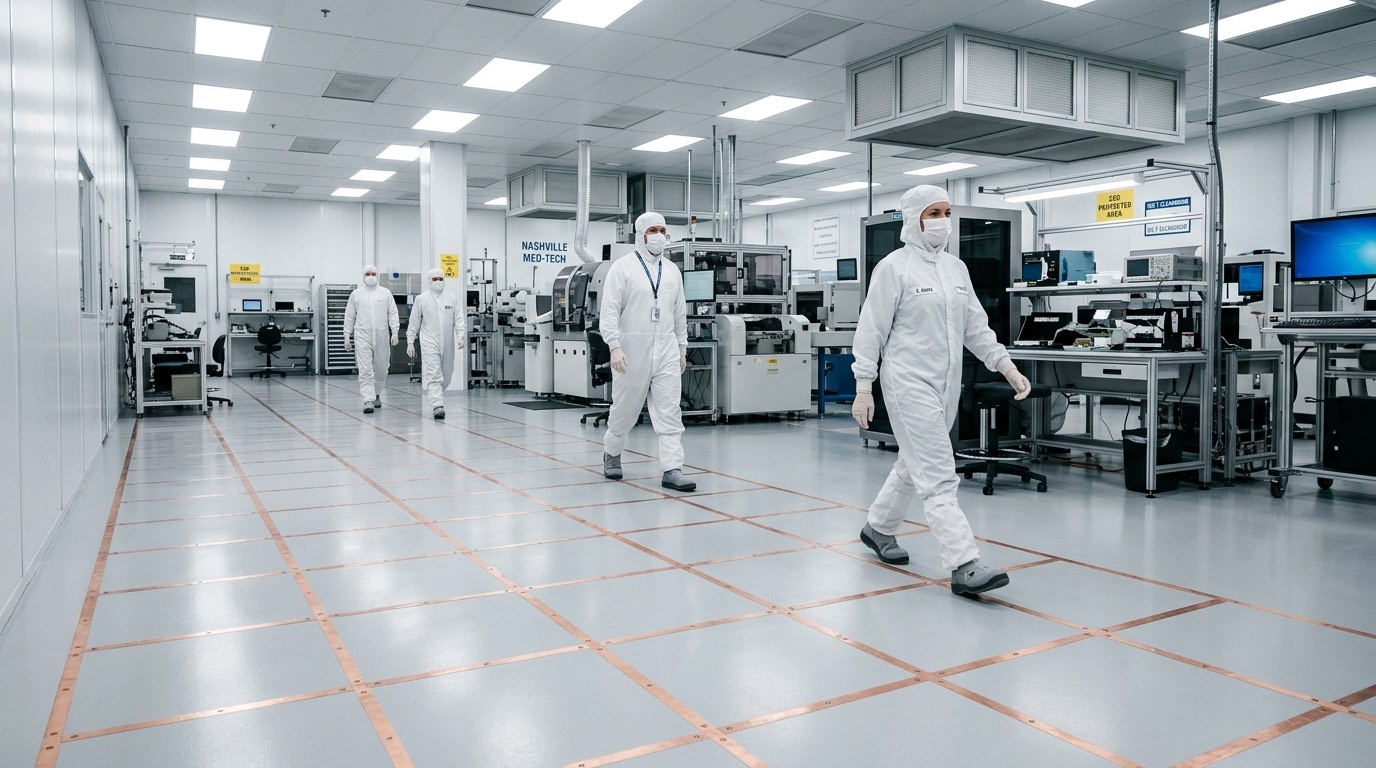
An ESD floor without a properly installed grounding system is compliance theater - it looks right, but doesn't function correctly. We install tinned copper grounding strips in a grid pattern under the coating, with grounding points connected to the facility's earthing network, and we document the grid layout for your compliance records. Before closeout, we test the floor using a surface resistance meter per ANSI/ESD S7.1, verify that point-to-ground resistance falls within the specified range across the whole area, and issue a signed test report. If the floor doesn't hit spec, we identify why and fix it - not something every installer will do. Our ESD Anti-static Epoxy Nashville team handles this on every Nashville job.
Ongoing Compliance Testing
ESD floors need to be re-tested periodically (annually is standard under most ESD program audits) because resistance can shift as the floor ages, as topcoats are reapplied, or as contaminants accumulate on the surface. We provide test reports at initial commissioning and offer annual or biannual compliance re-testing services for our ESD customers in Nashville. Call (888) 275-7078 to discuss your facility's requirements - we work with quality managers, EHS officers, and facility engineers to make sure your floor spec aligns with your ESD program documentation. Our ESD Anti-static Epoxy Nashville team handles this on every Nashville job.
ANSI/ESD S20.20 Compliance in Tennessee: What the Standard Actually Requires
ANSI/ESD S20.20 is the benchmark standard for electrostatic discharge control programs in electronics manufacturing and handling environments. The floor-specific requirement in S20.20 is a system resistance of 1 × 10⁶ ohms (1 megohm) to less than 1 × 10⁹ ohms (1 gigaohm) for ESD dissipative floors, and less than 1 × 10⁶ ohms for conductive floors, measured point-to-point and point-to-groundable point per ANSI/ESD STM7.1 test method. The floor does not stand alone: S20.20 requires that the floor system - coating plus footwear - achieve a body voltage of less than 100 volts (walking test per ANSI/ESD STM97.2) and a system resistance within the dissipative range. This means the floor coating must be tested in combination with the conductive footwear or ESD heel straps worn by personnel in the controlled area. We supply test reports for both the floor resistance measurement (post-installation, before occupancy) and the walking body voltage test so your ESD coordinator has documentation for S20.20 audit purposes. Tennessee-specific note: the high ambient temperatures and low relative humidity typical of Nashville summers (average summer afternoon RH of 45–55%) stress ESD control systems. Humidity drops below 30% RH during dry spells common between October and March, reducing the conductivity of materials that rely on moisture absorption (some antistatic mats and carpet tiles) rather than inherent conductivity. Our 100%-solids ESD epoxy systems derive their conductivity from a carbon black or stainless-steel fiber conductive matrix - not from moisture content - making them humidity-independent and reliable year-round in Nashville's highly variable climate.
ESD Floor Types: Dissipative vs. Conductive - Choosing the Right Specification
Not all ESD floors are the same, and the distinction between dissipative and conductive matters for your application. Dissipative floors (10⁶ to 10⁹ ohms) slow the discharge rate enough to prevent damaging charge spikes while avoiding the risk of a rapid discharge event that could injure a worker touching a grounded surface while carrying a charge. Dissipative floors are appropriate for general electronics assembly, component handling, and most semiconductor packaging environments where personnel interact with ESD-sensitive devices. Conductive floors (below 10⁶ ohms) provide faster discharge and are used in environments where the hazard is primarily flammable solvent vapor or explosive dust - the goal is to prevent any static accumulation, even briefly, because any discharge could ignite the atmosphere. Conductive floors are common in chemical processing facilities, ammunition and ordnance assembly (Nashville's defense-adjacent facilities near Luke Air Force Base and Nashville Gateway area), and anesthesia-delivery areas in hospitals. For most Nashville electronics manufacturing and defense contractor facilities, dissipative ESD epoxy is the correct specification. For ordnance handling, solvent spray booths, and explosive environments, we specify conductive systems. We will ask about your specific use case before recommending a resistance target - the correct answer is driven by what you are protecting against, not by the highest resistance number that still earns the "ESD" label.
Installation Process for ESD-Sensitive Environments
ESD epoxy installation in a live or partially live manufacturing environment requires more coordination than a standard commercial epoxy project. The grounding grid is the first installation step: we install a continuous copper foil grid beneath the conductive base coat, bonded to the building's ground system (verified with a ground impedance test before and after installation). The grid pitch - typically 10 feet by 10 feet for standard dissipative systems - ensures no point on the floor is more than 5 feet from a grounding conductor, keeping the discharge path short and consistent regardless of where a person stands. After the grid is embedded in the primer coat, the base coat (a 100%-solids epoxy with conductive matrix) is applied in two passes with a squeegee and spike roller. The topcoat - either an ESD dissipative clear urethane or an integral-color ESD epoxy - is applied after the base coat cures, typically the following day. The entire system is applied in positive-pressure rooms where possible to prevent contamination, and our crews wear static-dissipative footwear during installation to avoid generating charge on uncured coating. Post-cure (72 hours minimum), we perform the full ANSI/ESD STM7.1 point-to-point and point-to-ground resistance test across a grid of measurement locations covering the full floor area - not just a corner sample. The test report, with a site plan showing measurement locations and recorded values, is provided in a PDF report delivered to your ESD coordinator. Call (888) 275-7078 to discuss installation logistics for your Nashville facility, including clean-room-compatible installation protocols if your space requires contamination control during the work.
Industries ProEpoxy Serves for ESD Flooring in Nashville
Nashville's defense and aerospace cluster - anchored by Joint Base Nashville (Luke Air Force Base, Fort Campbell-Arnold AFS, Fort Campbell-Fort Campbell), Nashville Gateway area, and the Southwest Research Institute - represents a significant concentration of ESD-sensitive facilities within a 30-mile radius of downtown. Our ESD flooring installations in the Nashville metro span: avionics assembly and repair shops at Nashville Gateway area, where aircraft electronics components require ESD-compliant handling environments; contract electronics manufacturing facilities in the Rittiman and Northeast industrial corridors; semiconductor packaging and test facilities along the I-35 technology corridor; medical device manufacturing at South Tennessee Medical Center-adjacent facilities; data center and server room floor replacements where existing non-ESD coatings are being upgraded; and military contractor facilities with DCSA (Defense Counterintelligence and Security Agency) or TEMPEST-level physical security requirements that constrain installation team access and certification. We understand the security protocols of working in DoD-adjacent facilities: cleared crew members, escort requirements, prohibition of personal electronic devices on the floor, and pre-installation security briefings. If your Nashville defense or aerospace facility has specific contractor clearance requirements, contact us at (888) 275-7078 to discuss crew credentialing before scheduling an assessment.
Long-Term ESD Performance and Re-Testing
ESD floors degrade over time - through abrasion of the conductive topcoat, surface contamination from cleaning products that leave non-conductive residue, and mechanical damage in high-traffic zones. ANSI/ESD S20.20 compliance programs require periodic floor resistance testing - typically annually for manufacturing facilities. We recommend first retesting at 12 months post-installation and annually thereafter. If a test zone falls outside the acceptable resistance range, the cause is almost always one of three things: cleaning product residue that must be stripped with a conductive-compatible cleaner, topcoat wear in a high-traffic turning zone that requires a spot re-topcoat, or a damaged or corroded grounding connection (the most common in humid conditions near exterior walls). We maintain records of every ESD floor installation we have completed in Nashville so that if you call us for a re-test or repair, we already have the original installation data, ground grid layout, and initial test results on file. Call (888) 275-7078 for annual ESD floor testing or re-certification documentation for your Nashville facility.
ESD Flooring Maintenance: Protecting Your Investment and Your Compliance Record
An ESD floor is only as good as its maintenance program. The most common cause of ESD floor compliance failures in Nashville facilities is not installation defects - it is cleaning with incompatible products. Wax-based floor cleaners, silicone mop treatments, and standard floor polish compounds all leave a non-conductive residue film on the ESD topcoat that elevates floor resistance measurements above the 10⁹ ohm threshold. In severe cases - where wax has been applied monthly for 12–18 months - the floor can read as non-conductive even though the underlying coating is intact and functional. The fix is a chemical strip with an ESD-compatible stripper, a full dry period, and a re-test before returning to normal operations. We recommend three maintenance rules for ESD floors in Nashville facilities: 1) Use only pH-neutral, wax-free, ESD-safe cleaners - we provide an approved product list at installation. 2) Auto-scrub rather than mop - auto-scrubbers leave less cleaning solution residue, more consistently controlled. 3) Do not apply floor finish or floor sealer to an ESD surface under any circumstances. Beyond cleaning, protect high-traffic ESD zones from mechanical damage: use wheel casters rated for static-dissipative surfaces on equipment carts; avoid dragging metal equipment across the floor; and mark re-striping zones on the floor plan so that if a zone needs re-striping tape, an ESD-compatible tape is specified rather than standard vinyl. If your Nashville facility has been running an ESD maintenance program and is now failing periodic compliance tests, call us before replacing the floor - a cleaning-product residue strip-and-test costs a fraction of a re-installation, and in most cases resolves the resistance issue completely. (888) 275-7078.