Concrete Polishing Nashville: Polished Concrete in Nashville: A Floor That's Refined, Not Coated
Around Nashville, polished concrete has quietly become the default for breweries, boutiques, offices, and design-minded homeowners who are tired of coatings that peel. We run planetary Husqvarna and Lavina grinders and train our techs to CSDA standards, and we've polished everything from Downtown Nashville loft slabs to 50,000 sq ft retail floors out along the I-225 corridor - more than 150 polished-concrete jobs across the metro and counting. Our Concrete Polishing Nashville team handles this on every Nashville job.
Concrete Polishing Nashville: What the Diamonds Are Really Doing
Don't confuse polishing with buffing. It's a grind - a physical refinement that steps from roughly 30–50 grit up through 400, 800, and as high as 3,000 grit depending on how glassy you want it. Along the way we flood the slab with a lithium or sodium silicate densifier that reacts with free lime to grow calcium-silicate-hydrate crystals in the pores, stiffening the top layer by 20–40% on the Mohs scale. You end up with concrete that's harder and denser than it started - and sealed from within, so there's no film to delaminate.
Sheen and Stone: Designing the Look
The look of a polished floor comes down to two sliders you get to set: how much shine, and how much stone shows. Mix and match to hit the aesthetic you're after:
- Cream finish (no aggregate exposure): Minimal grinding that polishes only the cement paste surface. An even, understated look that reads well in homes and offices. Some of the slab's original character and marks stay visible.
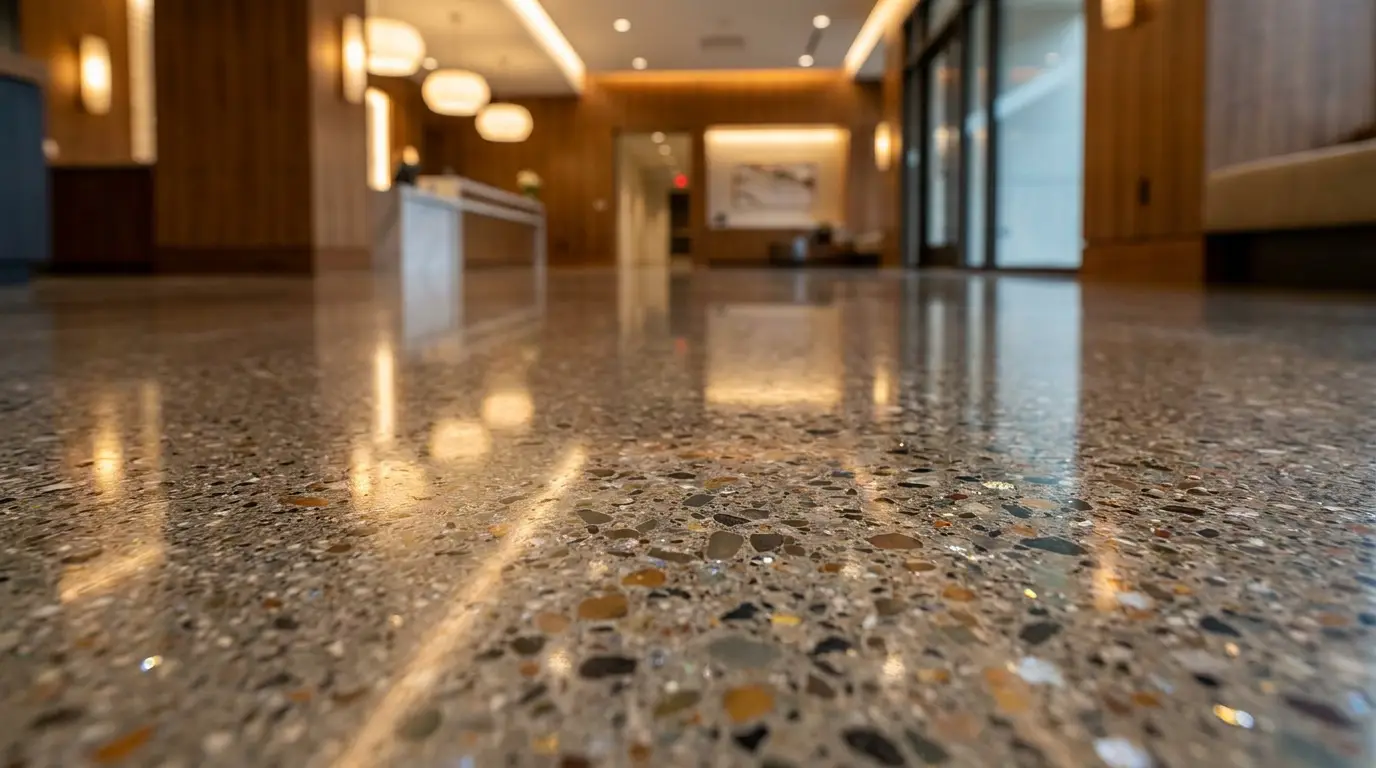
- Salt-and-pepper finish (fine aggregate): Light grinding reveals the fine aggregate fraction for a speckled appearance. Far and away our most-requested exposure for Nashville shops and restaurants - it hides traffic and adds subtle texture.
- Full aggregate exposure: Aggressive grinding reveals large stones and pebbles for a terrazzo-like appearance. Bold and one-of-a-kind - a favorite in hospitality and design-led retail.
- Gloss levels: From a flat matte (400 grit final) to a mirror-like reflectance (3,000 grit with burnishing). For most commercial floors we land around 800–1,500 grit - the sweet spot between clarity and toughness.
Polished Concrete and Green Building Credits
Polished concrete pulls real weight on green-building scorecards. Reusing the slab you already poured cuts new-material demand (LEED Materials & Resources), and its 70–80% light reflectance - versus about 30% for carpet - lets designers dial back fixture wattage and still hit IES light levels, which helps on the Energy & Atmosphere side. We've supplied polished floors for several Nashville projects chasing LEED Gold and Platinum.
Polished Concrete or Epoxy? How to Choose
It genuinely depends on the room. Polished concrete has no film on top, so nothing can peel or chip - it's the smart pick for busy retail, lobbies, and anywhere you want to forget the floor exists for 20 years (dust-mop, re-guard occasionally, done). Epoxy wins where you need aggressive chemical resistance, a seamless cove base, or bold color and pattern - garages, kitchens, wash-down areas. We install both and will tell you straight which fits. For a garage we'll usually point you to our epoxy garage system; for a facility our commercial team can price both on-site. Call (888) 275-7078 for a free slab assessment anywhere in the metro.
Nashville Slab Characteristics That Affect Polishing Outcomes
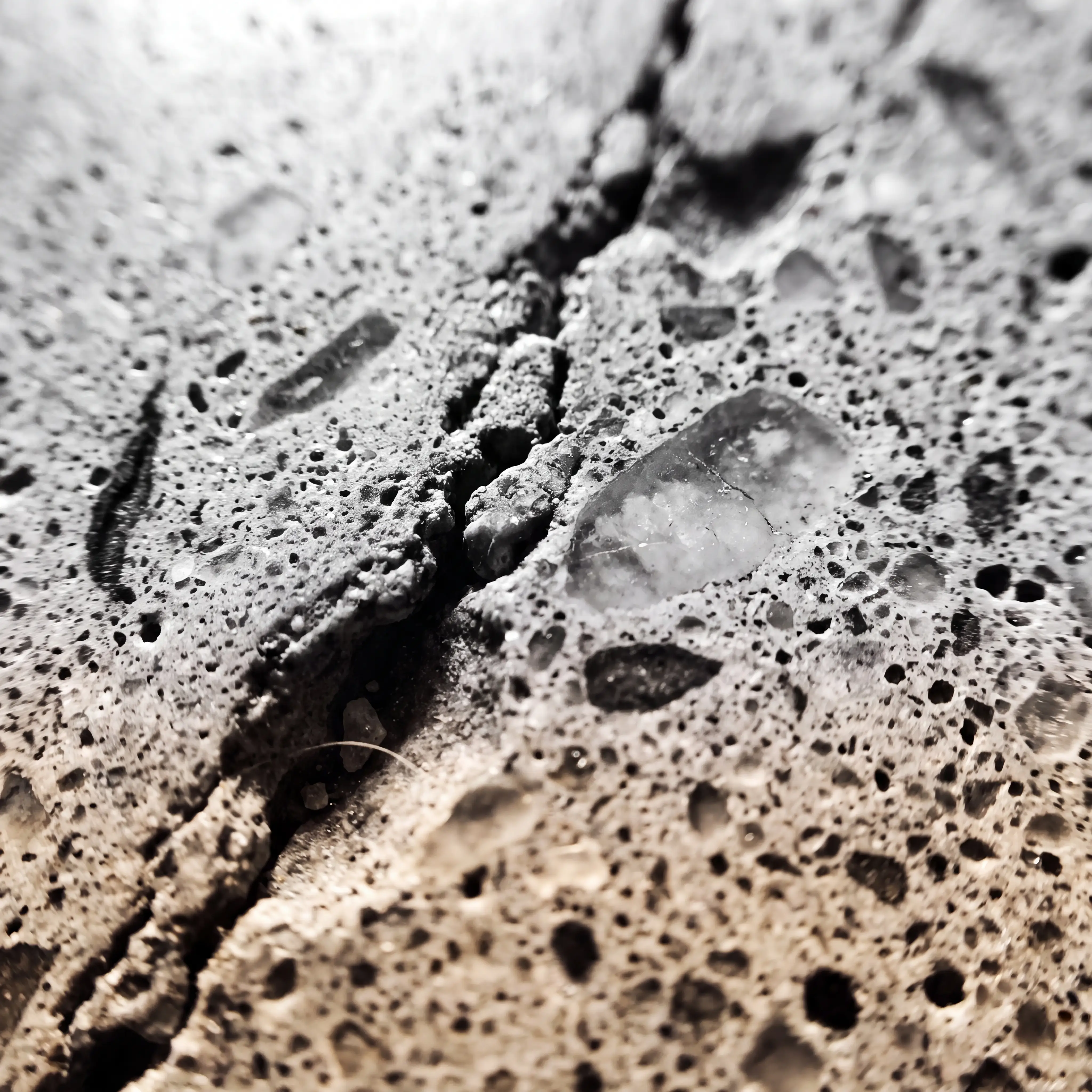
Not every slab polishes the same way, and Nashville slabs have specific characteristics that affect the process. Older downtown and Downtown Nashville slabs (1930s–1970s) often have a high lime content and relatively soft aggregate - they polish quickly and take on a warm, almost cream-colored finish. Newer post-tension slabs common in Belle Meade and the I-225 corridor tend to use harder limestone aggregate and a denser paste - they take longer to open up but produce a brighter, more reflective surface at the same grit level. Slabs poured on expansive clay (common throughout south and east Nashville) frequently show hairline crack networks from soil movement; these need to be filled with a color-matched slurry and grouted before polishing to prevent them from opening as visible lines in the finished floor. We assess all of these factors before committing to a final grit and finish target. What works on a The Nations / East Nashville arts district brewery slab is not necessarily what works on a 1970s warehouse floor in Brentwood.
Maintenance and Long-Term Performance
A properly polished and guard-coated floor in a Nashville commercial environment requires minimal upkeep compared to coated alternatives: daily dry dust mop (to remove the Tennessee red clay and sand tracked in from Tennessee driveways and parking lots), weekly damp mop with pH-neutral cleaner, and a re-application of penetrating guard every 2–5 years depending on traffic. No stripping, no waxing, no peeling to address. For Nashville retail and hospitality locations that operate 7 days a week with high foot traffic, polished concrete is typically the lowest-total-cost-of-ownership floor option over a 10-20 year horizon when maintenance labor is factored in alongside initial installation cost. We provide a written maintenance protocol with every polished concrete project and offer annual inspection visits for commercial clients who want documented floor condition records.
Guard Coats and When to Reapply in Nashville
A penetrating lithium silicate guard coat applied at installation densifies and seals the polished surface, providing stain resistance and reducing moisture absorption. In Nashville's Tennessee red clay-heavy environment, the guard helps prevent the calcium carbonate dust tracked in from driveways and construction zones from embedding in the concrete pores. Guard reapplication frequency depends heavily on traffic: a residential home sees guard reapplication every 3–5 years; a busy retail floor with 500+ daily visitors may need a light re-application annually. The sign that it's time: water applied to the floor surface no longer beads and absorbs instead. Guard coats are a simple site application that our team can complete in 2–4 hours for most residential and small commercial floors - we include the first reapplication with our polished concrete warranty program and notify clients when they're approaching the reapplication window.
Polishing Concrete That Already Has a Coating
Homeowners and facility managers sometimes want to convert an existing coated floor (epoxy, polyurea, or paint) to polished concrete. This is possible but adds a preparation step: all existing coatings must be completely removed to bare concrete before polishing begins. Partial removal leaves adhesion zones and color variation that telegraph through to the polished surface. Depending on the existing coating type and thickness, removal is accomplished by shot blasting, diamond grinding, or scarification - we assess the coating and concrete condition during the site visit and specify the removal method. In Nashville, old urethane and oil-based paint coatings in industrial buildings are the most common scenario for conversion to polished concrete; the concrete beneath is often in better shape than expected once the old coating comes off, and the polished result can be dramatic.
Where Polished Concrete Makes Sense in Nashville
Polished concrete is not the right answer for every Nashville slab - but for certain building types and use cases, it outperforms every other hard-surface flooring option in long-term value. Retail: high-gloss polished concrete in Nashville retail environments creates the clean, upscale aesthetic that resonates with shoppers, is easy to mop clean, and will not delaminate like vinyl plank or yellow like linoleum. Breweries and distilleries: concrete polishing is the de-facto floor finish in Nashville's craft beverage industry - it tolerates hops, barley slurry, and caustic keg-cleaning chemicals without coating failure, and looks correct in a working production environment. Luxury residential: homeowners in Mount Juliet, East Nashville, Smyrna, and Oak Hill are replacing carpet and tile with polished concrete in open-plan main floors and master suites. The thermal mass of polished concrete is a genuine benefit in Nashville - it absorbs heat during the day and releases it at night, reducing HVAC load in a climate where summer temperatures exceed 100°F for weeks at a time. Warehouses and distribution: a high-grit sealed polish on a warehouse slab eliminates concrete dusting, makes the floor easier to sweep and auto-scrub, and keeps the ambient light level higher from the reflective surface - reducing the energy cost of lighting a large distribution bay. For any of these use cases, the starting point is the same: an honest assessment of your existing slab. Some Nashville slabs are ideal candidates; others need repair work before polishing is viable. Call (888) 275-7078 to schedule a free slab assessment.
Densifiers and Hardeners: What They Do to Nashville metro Concrete
The chemistry at the core of polished concrete is a densifier - a colloidal silica or lithium silicate solution that reacts with free calcium hydroxide in the concrete matrix to form calcium silicate hydrate (C-S-H), filling the capillary pores and micro-cracks in the slab surface. This reaction hardens the concrete from within, reducing surface porosity by 30–50% and increasing surface hardness from a typical Mohs 3–4 to Mohs 6–7 after treatment and polishing. In Nashville's climate, densification is especially important: Nashville metro's Nashville clay soil causes significant slab movement through seasonal wet-dry cycles, generating microcracks in concrete that, if left untreated, allow moisture migration and surface spalling. Densified concrete resists this moisture migration, making the floor more stable in Nashville's rainfall-then-drought pattern. We apply densifiers at a specific stage in the grinding sequence - typically after the 400-grit pass, when the surface is open enough to absorb the liquid densifier but ground smooth enough that the reaction occurs uniformly. Applying densifier too early (at coarse grit) wastes material because the profile is too rough for consistent penetration; applying it too late (at fine grit) reduces penetration depth. Our crews use a wet-look indicator to confirm even densifier absorption before moving to the next grit. The result is a slab surface that is chemically different from what you started with - harder, denser, and ready to take a permanent shine.
For Nashville concrete that has been previously treated with curing compounds, form-release agents, or old coating residues, we add a degreaser-and-strip step before the initial grind. Curing compounds in particular - routinely applied to outdoor slabs and some warehouse floors to control moisture loss during the cure period - create a chemical barrier that prevents densifier penetration and causes polish streaking. The initial diamond pass removes the barrier layer mechanically; the strip-and-clean step removes any residual contamination. This two-stage prep adds cost but prevents the most common cause of poor polish quality on previously treated slabs: the customer who bought a mirror finish and got a hazy streak instead, because a contractor skipped the prep and went straight to fine-grit diamonds on a contaminated surface.
Polished Concrete Maintenance in Nashville's Climate
The most common misconception about polished concrete is that it requires no maintenance. Polished concrete requires less maintenance than tile, carpet, or vinyl - but it is not maintenance-free. In Nashville's environment, the two biggest threats to polished concrete are acid etching from citrus-based cleaners and mechanical abrasion from tracked-in Tennessee red clay and decomposed granite (common on Nashville's limestone and clay soils). Acid etching: Nashville's food-service industry favors citric acid-based cleaners and degreasers that, used on polished concrete without dilution, will etch the surface and permanently dull the gloss in the contact zone. The fix is pH-neutral cleaners exclusively - we provide a written maintenance guide with approved cleaner types and concentrations for every installation. Abrasive tracking: Nashville's Nashville metro-edge soil is highly abrasive. Commercial mats at all exterior entrances - changed weekly, not monthly - are the single most effective maintenance measure for polished concrete in Nashville retail and restaurant environments. Without entrance mats, tracked-in Tennessee red clay acts like a fine sandpaper on the polished surface, dulling the gloss within 6–12 months in high-traffic zones. With proper entrance mat coverage and pH-neutral cleaning, a commercial polished concrete floor in a Nashville retail or restaurant environment should retain its gloss for 5–10 years before the first re-polish is needed. Residential polished concrete in a Nashville home with good entrance mat coverage and no hard-soled shoes on the interior can retain its finish for 15–20 years with only periodic burnishing by a slow-speed floor machine. We provide a maintenance specification sheet with every installation and are available by phone for questions about cleaning products or procedures - (888) 275-7078.
Polished Concrete vs. Epoxy Coating: Which Is Right for Your Nashville Project?
Both polished concrete and epoxy coating are excellent choices for Nashville floors - but they serve different use cases. Polished concrete grinds and hardens the existing slab surface; it is the slab itself, made more refined. Epoxy is a coating applied on top of the slab. Polished concrete is the better choice when: the slab is in good condition with consistent aggregate exposure, the project is a commercial or residential interior where the natural concrete aesthetic is desired, the space needs maximum light reflectivity (retail, showroom, museum), or the long-term budget favors lower recurring maintenance costs. Epoxy coating is the better choice when: the slab has significant surface defects, staining, or contamination that would show through a polish, the project requires a specific color or decorative finish (metallic, flake, solid color), the environment involves heavy chemical exposure (industrial kitchens, labs, auto shops) where a sealed coating provides better chemical resistance than a polished surface, or the project is a garage, utility space, or outdoor-adjacent area where concrete dusting control is the primary goal. Some projects use both: polished concrete in the front-of-house dining room of a Nashville restaurant, epoxy in the back-of-house kitchen and prep area. We install both systems and can help you choose the right one for each zone of your project based on an honest assessment of your slab condition and use requirements - not on which product carries a higher margin for us. Call (888) 275-7078 for a free slab assessment and recommendation.