
Epoxy Garage Floor Nashville: Why Nashville Garages Need More Than a Big-Box Epoxy Kit
Walk into a hardware store in Nashville and you'll find $80 epoxy kits with optimistic label claims. Three summers later, most of those garage floors are bubbling, peeling at the edges, or chalked gray from UV breakdown. The Tennessee climate isn't the problem - the wrong product and skipped preparation are. A professional garage floor coating in Nashville is engineered differently from a residential kit: thicker films, UV-stable aliphatic topcoats, and proper diamond-grinding before a single drop goes down. ProEpoxy has installed over 400 garage floors across Nashville metro and the surrounding area, and we've seen every failure mode. Here's how we prevent them.
The Three Reasons Nashville Garage Floors Fail
First, hot-tire pickup: when a car sits all day in a Nashville summer and then pulls into the garage, the tires are soft and hot enough to chemically bond to a low-quality epoxy topcoat. They peel chunks off when the car moves again. The fix is an aliphatic polyaspartic or polyurea topcoat - these have the hardness and UV resistance to resist hot-tire transfer. Second, moisture vapor: Nashville sits on expansive clay soils that hold significant moisture. Vapor pushing up through the slab will lift any coating that wasn't primed with a penetrating, moisture-tolerant primer. We test every slab with a calibrated meter before specifying the primer. Third, adhesion failure from acid etching alone: acid etching opens pores but doesn't create the mechanical profile that epoxy needs. Diamond grinding to a CSP-2 or CSP-3 profile is required for coatings that will last.
What We Actually Install
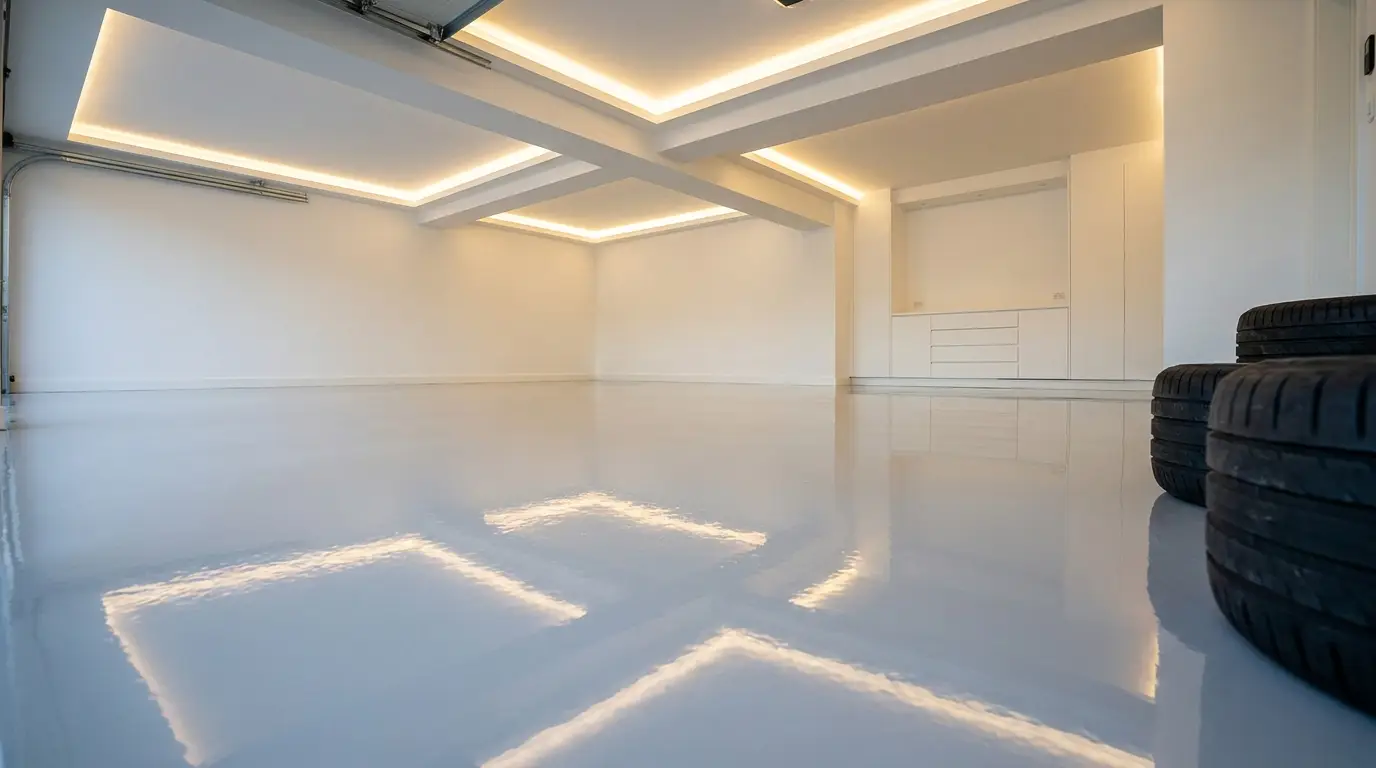
Our standard residential garage system is a two-coat 100% solids epoxy base with a polyaspartic topcoat - UV-stable, non-yellowing, and rated to 90+ on the Shore D hardness scale. The decorative flake broadcast goes into the wet base coat to add texture, hide slab imperfections, and improve slip resistance. For larger garages, workshops, and man-caves in neighborhoods like Mount Juliet, Smyrna, and Belle Meade, we also offer metallic epoxy and solid-color systems with a gloss that rivals polished concrete. Every job takes two full days on-site - day one for grinding, repair, and base coat; day two for topcoat - and the floor is back to light foot traffic in under six hours after the final coat.
Pricing and What the Numbers Mean
Garage epoxy in Nashville runs $3–$7 per square foot fully installed, depending on floor condition, system choice, and the amount of crack or joint repair needed. A two-car garage at 450 sq ft typically lands in the $1,800–$2,800 range for a standard flake system; a three-car with metallic epoxy will run higher. We price per scope, not per square foot off a rate card, so the number you get reflects what's actually involved in your slab. Most installs are scheduled within about a week of the quote - call (888) 275-7078 to book a free walkthrough anywhere in the metro.
Understanding Nashville's Garage-Specific Slab Conditions
Nashville garage slabs have specific failure patterns that differ from other regions. The Nashville metro and Rocky Mountain Tennessee limestone geology beneath most of the metro creates clay-heavy subbase conditions that expand and contract seasonally - causing slab movement and cracking patterns that appear cyclically rather than once. A crack that's been filled and looks stable in March can open again in October as clay dries. We seal active cracks with semi-rigid polyurethane injection that allows controlled movement while keeping the coating above stable, rather than rigid patches that just re-crack. The moisture vapor issue in Nashville - Tennessee red clay and clay soil retaining moisture year-round - means vapor testing is mandatory before we put any coating product down. We've refused to install over slabs that failed vapor testing and explained why to the homeowner; we've also watched other installers skip that step and gotten calls from the same homeowners six months later when the floor was bubbling.
The Neighborhoods We Work in Most
ProEpoxy has installed garage floors across the full Nashville metro. Our highest-volume residential neighborhoods include Belle Meade and North Aurora (large three-car garages common, homeowners investing in full-home renovation), Mount Juliet and Smyrna (older homes where slab prep is more involved, but clients want premium finishes), Aurora and Anthem (ranch-style homes with oversized garage and workshop spaces), Goodlettsville and Westminster (high-growth corridors with newer builds that have better slab conditions but need UV-stable systems), and Lebanon and White House (Arnold Air Force Station-adjacent communities where military families and defense contractors are common customers). We also work frequently in Goodlettsville, Gallatin, and Antioch. Same crew, same products, same warranty - the distance doesn't change the scope.
Comparing DIY vs. Professional Installation Outcomes
The Nashville hardware store sells DIY garage epoxy kits for $80–$200. The installations that come from those kits last 1–3 years on average under Tennessee conditions. We see them regularly - customers who call us after a DIY floor has peeled, bubbled, or discolored. The surface prep required for a professional-grade coating system is simply not achievable with DIY equipment: a rental floor buffer doesn't produce the CSP-2 diamond-ground profile that epoxy adhesion requires. Acid etching (the standard DIY method) opens pores but doesn't create mechanical profile and doesn't work at all on hard, burnished, or sealed concrete. A professional installation using commercial diamond grinders and 100% solids chemistry costs $1,800–$3,500 for a standard two-car garage. Done once, it lasts 15–20 years. The DIY version at $150–$200, redone every 2 years, costs more over the same period and provides an inferior result throughout. We're not the right choice for every budget - but for customers who want the floor done once correctly, the comparison holds up.
Color and Finish Selection for Nashville Homes
The most popular finish in Nashville residential garages is the full-broadcast chip system in neutral gray blends - Slate, Gunmetal, Oyster, and Silver blend are our four highest-volume chip colors for this area. These neutral tones suit the stucco and limestone aesthetic common in Nashville residential architecture, and they show dirt less than lighter colors while looking more refined than darker ones. For homeowners in newer subdivisions like Spring Hill, Columbia, and Brentwood who want a more distinctive look, we see more demand for Marble and Terrazzo blends and for two-tone applications. For workshop and workbench areas within the garage, solid-color gray or tan with a heavier aggregate anti-slip broadcast is the functional choice. We bring a full chip board and solid color deck to every assessment so you're making the decision from physical samples in your actual garage, under your actual lighting - not from photos on a device.
Moisture Testing: The Step That Protects Your Investment
Moisture vapor emission from concrete slabs is the primary cause of epoxy delamination in Nashville. The Caliche clay soils beneath most of Nashville hold water at depth year-round, and vapor migrates upward through the slab by concentration gradient. If the vapor emission rate exceeds what the coating can tolerate, pressure builds beneath the coating and pushes it off the concrete from below - often as blistering within the first year. This is entirely preventable with a $0 test and the right primer specification. We test every residential garage slab with a calibrated moisture meter before any product is applied. Slabs above threshold get a penetrating epoxy moisture mitigation primer that blocks vapor transmission rather than a standard primer that doesn't. We've never had a delamination failure attributable to vapor on a slab that was tested and correctly primed - because we don't install over slabs we don't understand. This adds 2–4 hours to the first day's process. It's non-negotiable on our side.
Crack Repair Options and What We Recommend
Most Nashville garage slabs have at least minor cracking by the time we're asked to coat them - the clay soil movement and thermal cycling create conditions for shrinkage and movement cracks to develop over 5–15 years. Control joint cracks (designed crack locations at saw-cut joints) are expected and not a structural concern. Shrinkage cracks (irregular, typically hairline to 2mm) are common and manageable. Active cracks (showing movement, opening and closing seasonally) require more careful treatment than stable ones. Our standard approach: hairline and stable cracks get a semi-rigid polyurethane surface fill; active cracks get low-viscosity polyurethane injection at depth before surface fill. We never use rigid cementitious patch material in Nashville garage slabs - the thermal expansion coefficient mismatch between cement patch and the surrounding concrete causes the patch to crack again within 1–2 years, and the crack reflects through the coating above. Polyurethane repair systems allow the slight movement that Nashville slabs actually experience in summer heat vs. winter cold. For cracks wider than 4–5mm or showing vertical displacement, we discuss the cause with you before coating anything - wide cracks can indicate subsidence or inadequate sub-base that warrants investigation before cosmetic treatment.
The Installation Day-by-Day
Day one of a standard two-car garage install: our crew arrives at 7–8 AM with the commercial diamond grinder. The garage is prepped - we need the floor empty, clear of vehicles and storage items before we arrive. Grinding takes 2–4 hours for a standard garage. After grinding, we vacuum and clean the surface, then apply the primer and crack repairs. If moisture testing shows elevated vapor, we apply the moisture mitigation primer at this stage. Day one ends with a base coat application, typically mid-afternoon. Day two: we broadcast the decorative chip into the base coat from the previous day's application. After broadcast and a short cure, we apply the clear polyaspartic topcoat. The crew is typically done by early afternoon on day two. Two hours after the final coat, the floor can be walked on. Vehicles can return in 24 hours. Full chemical resistance - meaning you can spill oil, antifreeze, or cleaners on it without concern - is reached at 5–7 days after the final coat. We provide a one-page care guide with every installation that covers the cure stages and what can be done during each.
Garage Extensions, Workshops, and Multi-Use Spaces
Many Nashville homeowners have garages that serve multiple functions - vehicle parking AND a workshop area AND storage AND sometimes an outdoor living spillover. The most common configuration we encounter in neighborhoods like Aurora, Antioch, and Columbia is a three-car garage with one bay configured as a woodworking or mechanical shop. These multi-use spaces often need differentiated floor treatment: the parking bays get the standard chip flake system, while the shop bay gets a solid-color system with heavier aggregate for workbench cleaning and tool use. We can install these as a single visit with a visual dividing line between the two finish zones - a common design choice is a saw-cut control joint between the parking and shop areas with a different chip color in each zone. For outdoor covered workshops and RV storage slabs, we can extend the same coating system to covered outdoor concrete that's shaded from direct sun, using the same chemistry with appropriate outdoor-grade aggregate in the topcoat.
Getting Your Quote: What We Need From You
The best quotes are on-site - we see the actual slab, identify existing problems, confirm the square footage, and assess access and logistics. On-site assessments across Nashville metro are free with no obligation. If you want a ballpark before scheduling a site visit, we can provide a range estimate from photos: send 4–6 photos of your garage floor (one from each corner toward the center, one of the most significant cracks or damage, one of the floor overall) along with the approximate square footage via email to info@proepoxynashville.com or by text to (888) 275-7078 and we'll give you a written range estimate within 24 hours. The range will typically be ±25% of the final installed price; the on-site quote narrows it to a fixed number. Either way, there's no pressure and no deposit to get a quote. We work by referral and reputation - we want you to feel comfortable with the process from the first contact.
Nashville's HOA and New Development Garage Market
Nashville's residential construction boom - centered on areas like Spring Hill, Columbia, Forest Hills, and the I-840 corridor - produces thousands of new garages annually, and homeowners in these planned communities often want to install epoxy flooring before moving in or during the first year of ownership. New slab conditions are generally better than aged slabs: fewer cracks, no oil contamination, consistent moisture profile. But new slabs also require a minimum cure time - we recommend at least 28 days from pour date before any coating installation; 60–90 days is better. If you're building and planning to coat the garage, include the floor coating in your construction timeline and schedule us for 60+ days after the slab pour. We'll coordinate directly with your builder on access and timing. HOA approval for floor colors and finishes varies by community; some HOAs require neutral colors for visible garage interiors. We've worked in virtually every master-planned community in the greater Nashville metro and can tell you what's typically required in your specific neighborhood before you commit to a color.
Pre-Sale Garage Floor Improvements
A coated garage floor consistently appears in the "features that helped close the sale" feedback we get from real estate clients and their agents in Nashville. Buyers notice a finished garage - it signals that the homeowner maintained the property carefully, and it photographs well for listing images. Sellers who invest $2,000–$4,000 in garage epoxy before listing often recoup 1.5–2× that in negotiated sale price according to feedback from agents we work with in the Mount Juliet, Belle Meade, and Belle Meade Proper markets. If you're listing within 60–90 days, let us know - we can prioritize your project in our schedule and use fast-cure polyaspartic chemistry so the floor is ready for photos within 24 hours of installation. We move quickly for pre-sale timelines and have completed several garage projects on 3–5 day notice when the listing date changed unexpectedly.
Detached vs. Attached Garage Considerations
Nashville homes vary significantly in garage configuration. Attached garages - connected to the living space, often with interior access door and HVAC penetrations - are common in newer homes throughout Belle Meade, Spring Hill, and the Briley Parkway corridor. Detached garages - freestanding structures in the backyard, common in older neighborhoods like Mount Juliet, Biltmore, and Camelback East - have different slab characteristics and coating requirements. Attached garages are typically better ventilated during installation (the interior door allows air circulation) but require more careful masking to prevent dust and fumes from entering the home. Detached garages in Nashville's older neighborhoods often have thinner, older slabs with more cracking and contamination from decades of use; they also tend to sit on higher-vapor substrates because they're not on elevated foundations. We identify the garage type and its implications during the initial assessment and note any special considerations in the written quote. For detached garages with significant concrete degradation - common in 50-70-year-old structures in Mount Juliet and Biltmore - we sometimes recommend concrete repair as a separate mobilization before coating.
RV, Boat, and Oversized Vehicle Storage
Nashville's suburban and semi-rural areas - Aurora, Anthem, Columbia, and communities along the US-I-840 corridor - include many homeowners who store RVs, boats, and trailers in oversized garages or covered storage slabs. These applications present specific loading and chemistry challenges: RV tires are wide and exert concentrated loads; fifth-wheel king-pin stands and stabilizer jacks create point loads that can exceed 2,000 lbs per sq ft for brief periods; and RV exhaust and sewage connection areas create localized chemical exposure. Our heavy-vehicle garage specification uses a thicker base coat (minimum 20 mils total DFT instead of the residential standard 15–18 mils), higher-elongation polyurea base coat instead of standard epoxy to handle the point-load stress, and heavier aggregate broadcast for traction under heavy tire traffic. We've coated RV storage and boat storage slabs in Aurora, Columbia, and Antioch where the flooring performance requirements are closer to a light commercial application than a standard residential garage. Pricing for oversized vehicle storage floors reflects the heavier specification: $6–$10 per sq ft installed for standard sizes.
Garage-to-Living Space Conversions
Garage conversions - turning a garage space into a home gym, home office, or bonus room - are increasingly common in Nashville as housing costs rise and homeowners maximize usable square footage without a full addition. The flooring decision for a converted garage is more demanding than a standard garage coating because the space now needs to function as a living area rather than a utilitarian work space. Key considerations: the slab in a converted garage is often cold in winter because it has no insulation below (unlike an interior slab over conditioned crawl space); the floor needs to be comfortable underfoot for extended standing and walking; and the finish needs to read as residential rather than industrial. Our converted garage specification typically uses a full decorative chip system with a high-gloss polyaspartic topcoat - the chip pattern adds warmth and the high gloss reflects light effectively in what is often a space with limited natural light. For home gyms specifically, we add a rubber-infused broadcast layer under the topcoat to provide some cushioning underfoot. For home offices and bonus rooms, metallic epoxy is a popular upgrade that makes the converted space feel intentionally designed rather than adapted.
Garage Coatings for Nashville's Military and Fort Campbell Community
Joint Base Nashville and its associated communities - White House, Lebanon, Westminster, Nolensville, and Arnold Air Force Station-adjacent zip codes - have one of the highest concentrations of homeowners with extended on-base housing and off-base rental histories in the country. Military families returning to base after deployments or PCS moves often choose to invest in the home they're renting or have purchased in the Nashville metro, and garage floor coating is consistently one of the first projects they tackle. We work frequently with Fort Campbell-area homeowners on a quick, professional garage floor install that can often be scheduled and completed within a 2-week window - fast enough to be done before the household goods arrive. For PCS scenarios specifically, we keep a reservation priority in our schedule for military customers with confirmed PCS orders and a defined move-in date - call (888) 275-7078 and mention your PCS timeline and we'll accommodate what we can.
Garage Floor Coating and Neighborhood Property Value
In Nashville's competitive residential market - particularly in high-appreciation neighborhoods like Mount Juliet, Smyrna, Belle Meade, and Antioch - home improvements that increase visual appeal and reduce buyer objections move properties faster and command higher offers. A coated garage floor does both: it eliminates the "needs maintenance" perception that bare stained concrete creates, and it photographs well for listing images where the garage is often prominently featured in wide-angle exterior shots. Nashville real estate agents we've spoken to in these neighborhoods consistently note coated garages as a "no objection" item in buyer feedback - buyers don't negotiate on a clean, finished garage the way they might on an old carpet or dated kitchen finish. The ROI calculation is straightforward: a $2,500–$4,000 garage floor installation in a home listed at $500,000+ is noise in the transaction, but it eliminates a visible maintenance item that buyers' agents will flag in the offer letter. We do several pre-listing garage installs every month in the Mount Juliet, Belle Meade, and Far North Nashville market - often on 1–2 week timelines at the seller's agent's request.
Tenant Finish-Out: Garage Floors in Nashville Rental Homes
Residential landlords in Nashville - from individual investors with 2–3 properties to property management companies managing hundreds of single-family rentals in Westminster, White House, and the Northeast side - increasingly specify epoxy garage floors as a standard amenity in tenant finish-outs. The reasons are practical: bare concrete in a rental garage deteriorates quickly from tenant use, and the cost of pressure washing, crack repair, and paint touchup at each tenant turnover eventually exceeds the cost of one professional epoxy installation that a tenant can use for 5+ years without visible degradation. We offer volume pricing for landlords and property management companies managing multiple Nashville properties - call (888) 275-7078 to discuss your portfolio and pricing terms. For property managers coordinating work across multiple units, we handle scheduling coordination directly and can sequence multiple installs in a building or neighborhood within a single scheduling block.
Aggregate Broadcast Density and Texture Choices for Nashville Garages
The broadcast density and chip size in a flake system affect both the finished appearance and the surface texture. A full-broadcast (rejection broadcast) system - where chips are thrown until the wet epoxy can accept no more - creates a uniform, tile-like appearance with high coverage that many Nashville homeowners prefer for its clean look and easier surface maintenance. A partial broadcast at 50–70% chip density creates a more speckled, terrazzo-like appearance where some base coat color shows through between chips. Both are valid aesthetics; we typically show physical samples of each density at the estimate visit so the choice is made visually rather than described in the abstract. Chip size options range from 1/16" (fine, subtle texture) to 1/4" (bold, pronounced pattern). Nashville homeowners tend to prefer medium chip sizes (1/8" is our most requested size) for residential garages because it provides enough visual texture to read well in photography while remaining easy to sweep and mop. Specialty chip blends - granite-look blends, earth tones, solid accent colors - are available through our supplier network and we carry sample boards for the most popular configurations in the Nashville market.
Garage Floor Coating for New Construction in Nashville
New construction in Nashville - particularly in rapidly growing subdivisions in Lebanon, Nolensville, Westminster, Goodlettsville, and the far northwest side (Aurora, Columbia, Antioch) - creates a specific situation for garage floor coating: the concrete slab is typically 28–60 days old when a new homeowner takes possession, which falls in the ideal window for diamond grinding and coating. The concrete is fully cured but hasn't had time to accumulate contamination from vehicle traffic. We work directly with new homeowners on warranty-period installations and are familiar with the slab specifications from major Nashville area builders including Ole South Properties, Signature Homes, Drees Homes, and Meritage Homes. New construction slabs in Nashville are typically 4" thick with wire mesh reinforcement at grade; most meet our substrate quality requirements without extraordinary prep. The main variable in new construction is whether the builder applied a curing compound - some do, some don't - and we test for this at the estimate. A curing compound requires either mechanical abrasion or chemical removal before the epoxy primer can bond properly.