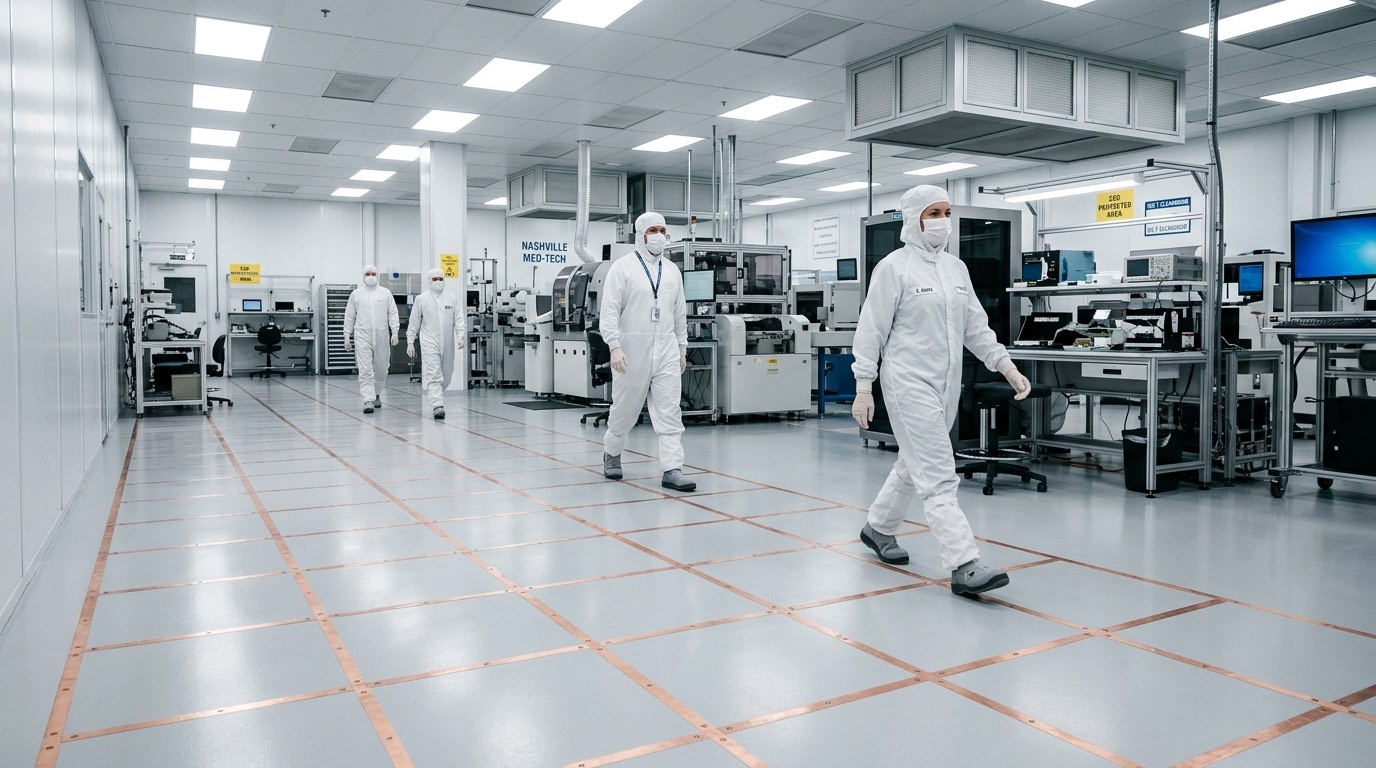
A single uncontrolled electrostatic discharge event can destroy a $40,000 circuit board assembly, corrupt a medical device, or trigger a cleanroom contamination protocol. Nashville's growing healthcare sector, electronics manufacturing base, and expanding data center footprint all depend on flooring that actively controls static electricity - not just resists it. Standard epoxy does not meet this requirement. ESD anti-static epoxy Nashville systems do.
What Is ESD Epoxy Flooring and Why Nashville Facilities Need It
ESD stands for Electrostatic Discharge - the sudden flow of electricity between objects at different electrical potentials. In everyday life, it's the shock you feel touching a doorknob. In a semiconductor assembly line or hospital operating room, it's a failure event that can destroy equipment worth tens of thousands of dollars or compromise patient safety.
ESD flooring is a specially formulated epoxy system containing conductive or dissipative additives - typically carbon black, conductive fibers, or metallic particles - that give the floor a controlled electrical resistance. When connected to a grounding system, the floor creates a continuous path that safely dissipates static buildup rather than allowing it to accumulate and discharge.
Standard epoxy flooring has surface resistance in the range of 1010 to 1012 ohms - effectively an insulator. Walking on it builds static charge. ESD epoxy is engineered to fall in the 106 to 109 ohm range (dissipative) or below 106 ohms (conductive) - a range that prevents dangerous charge buildup while controlling discharge rate.
Nashville's ESD demand is growing: HCA Healthcare and Vanderbilt University Medical Center are among the largest healthcare employers in the United States. Middle Tennessee's medical device manufacturing and electronics assembly sectors add thousands of ESD-sensitive workstations that require compliant flooring per ANSI/ESD S20.20.
ANSI/ESD S20.20 Compliance: Nashville Floor Specification Requirements
The governing standard for ESD control programs in the United States is ANSI/ESD S20.20, published by the ESD Association. For flooring specifically, the standard defines two compliance categories based on measured surface resistance:
| Floor Type | Resistance Range | Classification | Typical Applications |
|---|---|---|---|
| Conductive ESD Epoxy | Below 1 × 10⁶ ohms (<1 MΩ) | Conductive | Semiconductor fab, explosive handling, high-sensitivity electronics |
| Dissipative ESD Epoxy | 1 × 10⁶ to 1 × 10⁹ ohms | Dissipative | Medical devices, hospital ORs, cleanrooms, PCB assembly, data centers |
| Standard Epoxy | Above 1 × 10⁹ ohms | Non-compliant | Not suitable for ESD-sensitive environments |
Post-installation resistance testing is a requirement of ANSI/ESD S20.20 compliance, not an option. ProEpoxy Nashville provides full post-installation resistance documentation with every ESD flooring project - a specification sheet recording measured resistance values at standardized test points across the floor surface.
Conductive vs Dissipative ESD Epoxy: Which Does Your Nashville Facility Need?
The choice between conductive and dissipative ESD flooring depends on your specific application and what your facility's ESD control program specifies:
- Dissipative ESD epoxy (106–109 ohms) is the most common specification for Nashville facilities. It dissipates static slowly enough that a person walking across it doesn't experience a sharp discharge, while still preventing the charge accumulation that damages sensitive equipment. Suitable for most medical, cleanroom, and electronics environments.
- Conductive ESD epoxy (below 106 ohms) dissipates charge faster - required in environments with the most sensitive components or where ignition from static discharge is a concern (explosives handling, fuel system areas). Installed with a copper grounding tape grid embedded beneath the coating layer.
Both systems require connection to a facility ground. ProEpoxy Nashville installs the grounding system as part of the flooring scope - no separate electrical contractor required for the floor ground.
Nashville Industries That Require ESD Anti-Static Flooring
ESD Epoxy Flooring Cost Nashville and Installation Process
| System | Includes | Nashville Cost / sqft |
|---|---|---|
| Standard commercial epoxy | Primer + base + topcoat, no ESD | $3–$7 |
| Dissipative ESD epoxy | Conductive primer + ESD base + topcoat + ground | $6–$10 |
| Conductive ESD epoxy | Copper tape grid + conductive base + topcoat + ground | $9–$12 |
| With resistance testing documentation | Full system + post-install ANSI/ESD test report | $+1–$2 |
The cost premium over standard epoxy reflects the specialized conductive materials and grounding installation - not a significant markup when measured against the cost of a single ESD event that destroys equipment or triggers a recall. Nashville facilities that require ANSI/ESD S20.20 documentation for regulatory compliance or insurance purposes should specify the resistance testing add-on at the quote stage.
Installation process mirrors standard commercial epoxy flooring Nashville: diamond grinding, primer coat, body coat, topcoat. The difference is the conductive or dissipative additives in the product system and the grounding tape installation beneath the base coat. Most Nashville ESD floor installations complete in 1–2 days depending on facility size.
ESD Anti-Static Flooring Nashville - Common Questions
Get Your Nashville ESD Flooring Quote and Specification
ProEpoxy Nashville installs full ESD anti-static epoxy Nashville systems for electronics manufacturers, healthcare epoxy flooring Nashville facilities, cleanrooms, and data centers. We provide product data sheets, post-installation resistance testing documentation, and ANSI/ESD S20.20 compliance support. Get your Nashville ESD flooring specification - we'll specify the right system for your application and provide resistance range documentation before installation begins.