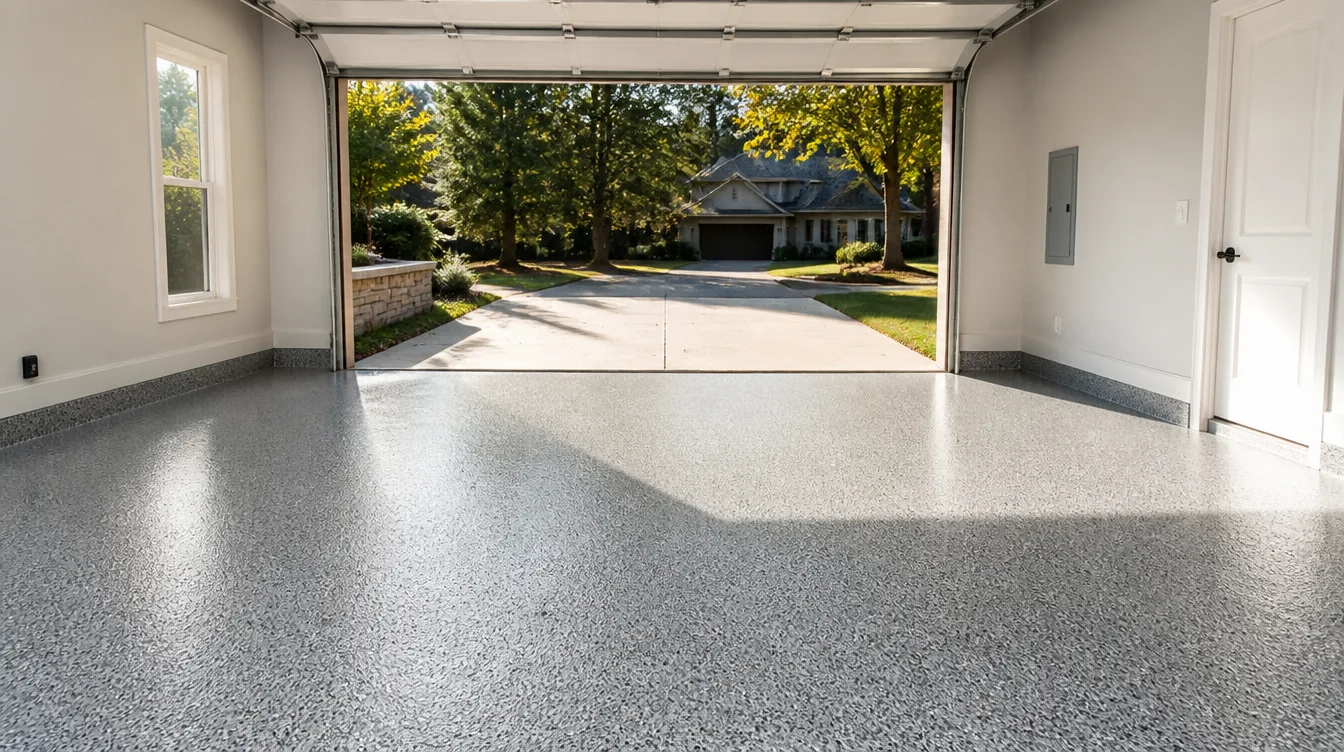
Polyaspartic floor coating UV stability in Nashville comes down to a specific piece of chemistry: aliphatic resin structure versus aromatic resin structure. If you've ever seen a standard epoxy garage floor take on a faint yellow or amber tint after a few years of direct sun exposure, you've seen aromatic chemistry breaking down under UV light - and it's exactly the failure mode polyaspartic coatings are formulated to avoid.
For any Nashville space that sees real sun exposure - a south-facing garage, an open-door showroom, or a covered outdoor patio - understanding this chemistry difference is the difference between a floor that looks the same in ten years and one that visibly ages within the first two or three summers.
What Causes Floor Coatings to Yellow
Yellowing in floor coatings happens when ultraviolet light breaks down chemical bonds in the resin, altering how the material absorbs and reflects light. The result is a visible amber or yellow tint that gradually intensifies with continued sun exposure, and once it starts, it doesn't reverse - the only fix is recoating or a new topcoat.
This isn't a defect or an installation mistake. It's an inherent property of the resin chemistry used in the coating, which means even a perfectly installed floor using the wrong resin type for a sun-exposed space will eventually yellow, regardless of how carefully the installation itself was done.
Aliphatic vs Aromatic Chemistry Explained
The distinction between aliphatic and aromatic chemistry is a matter of molecular ring structure. Aromatic compounds contain a benzene ring structure that's excellent for building strength and hardness into a coating, but that same ring structure is highly reactive to UV light - the energy from sunlight breaks those bonds over time, producing the yellow discoloration.
Aliphatic compounds don't contain that reactive ring structure, which means UV light has essentially nothing to break down in the same way. This is why polyaspartic coatings, which are formulated with aliphatic polyurea/polyurethane chemistry, hold their original color under sustained sun exposure where an aromatic epoxy topcoat would gradually shift toward yellow or amber.
The key distinction: Standard epoxy resin is aromatic by nature - this is true across virtually all epoxy topcoats regardless of brand. Polyaspartic is formulated with aliphatic chemistry specifically because it's applied as a topcoat in situations where color retention over time matters.
It's worth noting that the epoxy base coat itself is often fine to use in a UV-exposed space, since it's typically covered by a topcoat and doesn't see direct sunlight. The UV stability question really comes down to what topcoat is on top of that base coat - an aliphatic polyaspartic or polyurethane topcoat over a standard epoxy base gives you the strength of epoxy with the color stability of aliphatic chemistry where it matters most.
Where UV Stability Matters Most in Nashville
Not every floor needs UV-stable chemistry - an interior warehouse floor with no direct sun exposure will never see the yellowing issue regardless of which resin type is used. But for specific categories of Nashville spaces, UV stability is one of the most important factors in the entire flooring spec.
- South and west-facing garages - garage doors facing south or west see the most direct, prolonged sun exposure of any residential flooring application
- Covered and open patios - outdoor and semi-outdoor living spaces are exposed to full UV year-round with no interior shading
- Retail and automotive showrooms - large storefront windows flood showroom floors with direct sunlight for much of the day
- Parking garages and structures - open-air and partially covered parking structures see significant UV exposure across large floor areas
Our parking garage epoxy Nashville page covers UV-stable specifications in more depth for exactly this kind of large, sun-exposed commercial application.
Long-Term Color Retention Expectations
A properly installed polyaspartic floor in a sun-exposed Nashville space should hold its original color for well over a decade, since the aliphatic chemistry simply doesn't have the reactive bonds that drive yellowing in the first place. This is a meaningfully different expectation than a standard aromatic epoxy topcoat in the same location, which can begin showing visible color shift within just a few years of direct summer sun exposure.
| Coating Type | Chemistry | UV Color Retention |
|---|---|---|
| Standard epoxy topcoat | Aromatic | Yellows within 2-5 years in direct sun |
| Polyaspartic topcoat | Aliphatic | 10+ years, minimal color shift |
| Polyurethane topcoat | Aliphatic | 10+ years, minimal color shift |
This is also why polyaspartic has become the default topcoat recommendation whenever we scope a polyaspartic floor coating Nashville project for a space with meaningful sun exposure - the chemistry advantage isn't a marginal upgrade, it's the difference between a floor that looks the same on its tenth anniversary and one that's visibly discolored well before then.
For homeowners and business owners comparing polyaspartic against standard epoxy more broadly - not just on UV stability but cure time, durability, and cost - our polyaspartic vs epoxy deep dive walks through the full comparison. And if your project timeline involves colder installation conditions on top of UV exposure concerns, our guide to polyaspartic cold weather installation in Nashville covers how temperature affects the cure process.
Real-World UV Exposure Scenarios
A homeowner with a south-facing three-car garage in a Nashville suburb like Brentwood or Franklin is a textbook case for prioritizing UV stability. With the garage door open for much of the day during warmer months, that floor sees direct, intense sunlight that would visibly yellow a standard epoxy topcoat within the first two or three summers - polyaspartic avoids that outcome entirely, and its faster cure time is a practical bonus for a space that needs to go back into daily use quickly.
Commercial showrooms present an even more visible stakes scenario, since a yellowing floor directly undercuts the polished, premium appearance a showroom is trying to project to customers walking through large storefront windows. A car dealership or retail showroom with floor-to-ceiling glass frontage is exactly the kind of space where the extra cost of a polyaspartic topcoat pays for itself in maintained appearance alone, well before factoring in its faster turnaround time for a business that can't afford extended downtime.
Outdoor and covered patio installations face the added variable of direct weather exposure on top of UV, including temperature swings and moisture that a garage or interior showroom never sees. In these applications, polyaspartic's combination of UV stability and flexibility under thermal cycling makes it close to the default recommendation rather than one option among several, since the alternative - a coating that both yellows and eventually cracks under seasonal temperature swings - creates two separate long-term problems instead of one.
It's also worth planning ahead for spaces that might change use over time. A garage currently used for parking that a homeowner later converts into a home gym or workshop will keep getting the same direct sun exposure through the open door regardless of what the room is used for day to day, so specifying UV-stable chemistry upfront avoids having to recoat the floor later just because the room's function changed. The same logic applies to commercial spaces being built out speculatively - a shell space with south-facing glass that hasn't been leased yet will see the same sun exposure no matter what tenant eventually moves in, so it rarely makes sense to cut costs on the topcoat chemistry to save money on a spec that will need to be redone within a few years regardless of final use.
One more practical consideration: because polyaspartic cures significantly faster than standard epoxy, it's often the better choice even in cases where UV exposure is only a moderate concern, simply because it gets a garage, showroom, or commercial space back in service in a fraction of the downtime. When both fast turnaround and long-term color stability are relevant to a project, that combination is difficult for standard epoxy to compete with on either count.