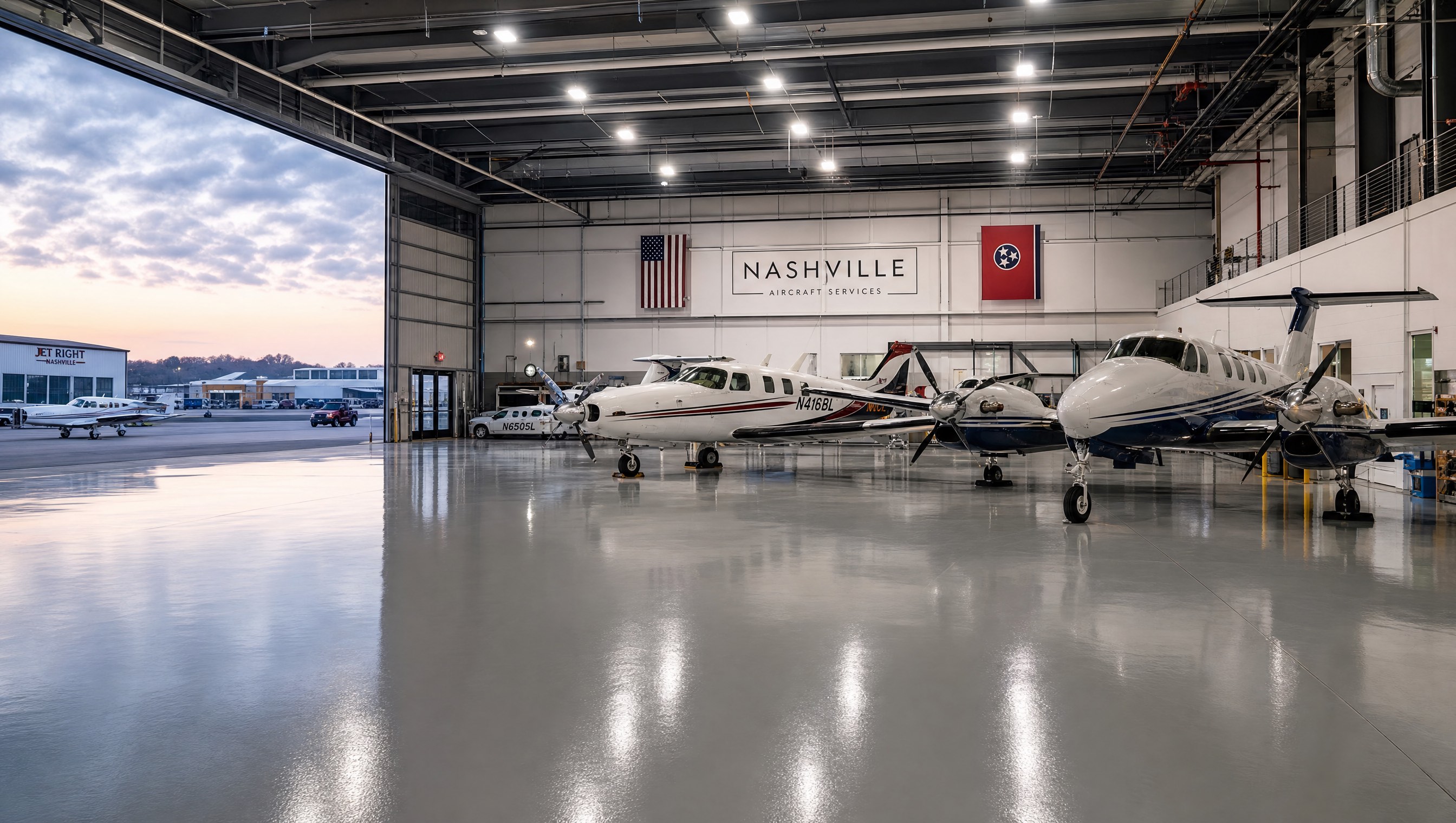
Nashville's general aviation and commercial aircraft hangars - from John C. Tune Airport on the west side to BNA Nashville International's corporate hangar row to the Tennessee National Guard facilities at Smyrna - require a floor specification unlike any other commercial or industrial building type. Fuel exposure, static discharge risk, and specific military and aviation industry standards all shape what goes on a hangar floor. This guide covers the aviation-grade epoxy specifications Nashville hangar owners and operators need to know.
Why Nashville Aircraft Hangars Require Specialized Epoxy Floors
Standard commercial commercial epoxy flooring Nashville is not rated for aviation environments. Aircraft hangars present a hazard profile that most commercial buildings never encounter:
- Jet-A fuel and avgas exposure - fuel spills and vapor from refueling and maintenance operations attack standard epoxy chemistry and, more critically, create explosive vapor conditions
- Hydraulic fluid and de-icing chemicals - aircraft hydraulic systems and winter de-icing fluid (propylene glycol and similar) both require chemical-resistant flooring beyond standard specifications
- Static discharge risk - fuel vapor combined with static electricity discharge is a documented ignition hazard in hangar environments; standard flooring does not address this risk at all
- Heavy point loads - aircraft landing gear and maintenance equipment (jacks, tugs, lift stands) apply concentrated loads that standard commercial epoxy is not engineered to handle repeatedly
Aviation-Grade Epoxy Specifications: Fuel and Chemical Resistance
The correct hangar floor specification starts with 100% solids aromatic epoxy chosen specifically for chemical resistance to aviation fuels and fluids - not the same formulation used in a standard warehouse. Key specification elements:
Static-Dissipative Epoxy for Nashville Airport Hangars
The single most important specification difference between a standard commercial floor and a hangar floor is static dissipation. Fuel vapors present during refueling, maintenance, and fueling truck operations create an environment where uncontrolled static discharge is a genuine fire risk - this is why ATA 103 (Air Transport Association specification) governs hangar and ramp floor requirements.
Static-dissipative epoxy floors are engineered to achieve a specific electrical resistance range:
- Below 10^4 ohms - fully conductive, used in specific high-risk fuel handling zones
- 10^4 to 10^6 ohms - static-dissipative range, the standard specification for general hangar floor areas per ATA 103
- Above 10^6 ohms - insulative, inadequate for hangar static control requirements
Resistance must be tested and documented at installation, and Nashville hangar operators - particularly those under lease agreements with airport authorities - should expect to provide this documentation as part of facility compliance records.
Military spec note: Facilities operating under Tennessee National Guard or federal contracts at Smyrna Airport may need to meet MIL-PRF-24667, the U.S. military specification for aircraft hangar deck coatings. This spec has additional requirements beyond commercial ATA 103 and should be confirmed with the facility's contracting requirements before installation.
John C. Tune and BNA Hangar Floor Compliance Requirements
Nashville's aviation facilities span a range of operational types, each with somewhat different practical requirements:
- John C. Tune Airport - general aviation facility on the west side of Nashville; hangar floors here typically follow standard commercial-plus-static-dissipative specifications rather than full military spec, since the airport primarily serves private and corporate general aviation
- BNA Nashville International - commercial and corporate hangar operations at BNA follow airport authority lease requirements, which frequently specify ATA 103 static-dissipative flooring as a condition of hangar lease agreements
- Smyrna Airport - mixed military and civilian use means some hangars at Smyrna may require MIL-PRF-24667 compliance depending on tenant and use classification
Before specifying a hangar floor system, confirm the exact compliance requirement with the airport authority or facility lease documentation - the difference between standard commercial epoxy, ATA 103 static-dissipative epoxy, and MIL-PRF-24667 military spec meaningfully changes both cost and installation complexity.
Aircraft Hangar Epoxy Cost Nashville and Large-Area Pricing
Nashville general aviation hangars typically range from 5,000 to 20,000 square feet, and volume pricing applies at that scale:
| System | Application | Cost per Sq Ft |
|---|---|---|
| Standard commercial hangar epoxy | No ESD requirement, chemical-resistant only | $4–7 |
| Aviation-grade static-dissipative epoxy | ATA 103 compliant, fuel-resistant | $6–12 |
| MIL-PRF-24667 military spec system | Federal/military contract compliance | $10–16 |
Large hangar floors (10,000+ sq ft) typically see per-square-foot pricing at the lower end of these ranges due to material and labor efficiency at scale. Smaller general aviation hangars under 5,000 sq ft see pricing at the higher end due to fixed mobilization and equipment costs.