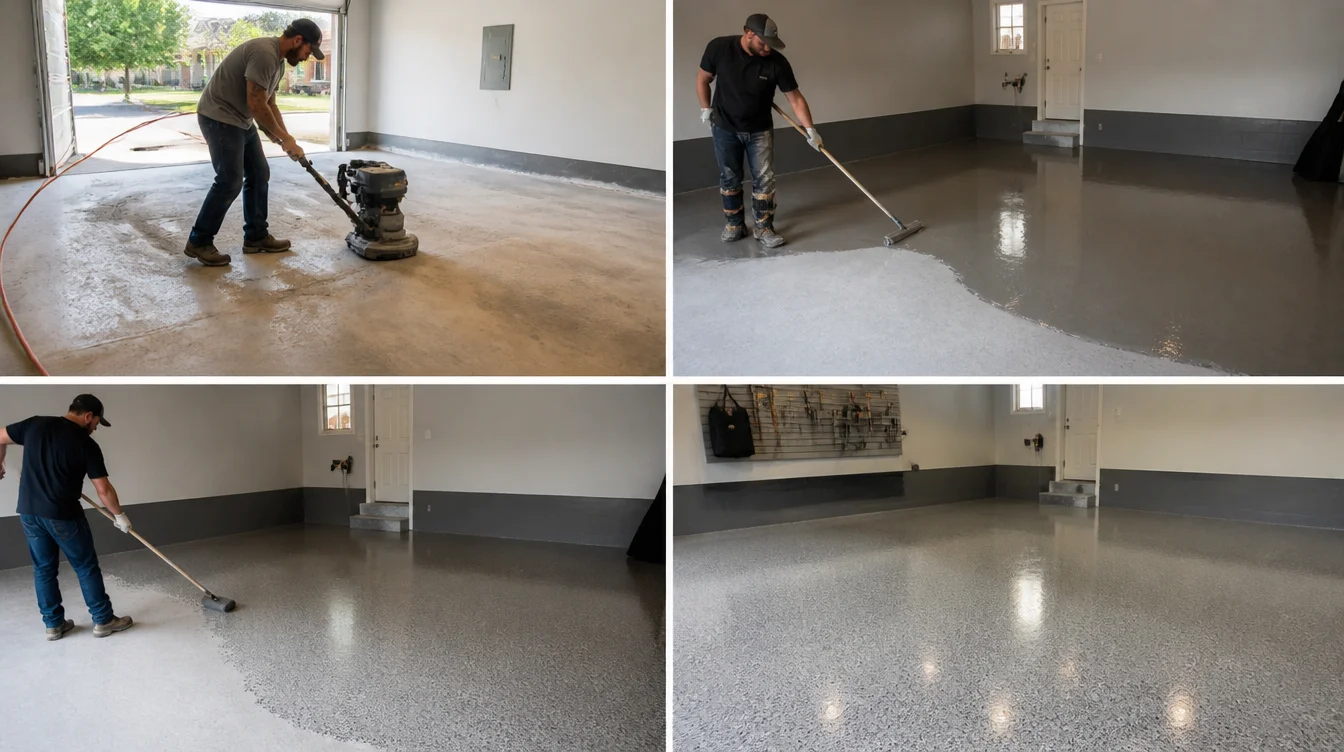
The polyaspartic one-day install process is exactly what it sounds like: a full floor coating, from bare concrete to finished glossy surface, completed in a single day. That's a real advantage over the standard 2-day epoxy timeline, and it's why Nashville contractors reach for polyaspartic whenever a homeowner or business needs their floor back in service fast. Here's what actually happens during a one-day install, hour by hour.
Why Polyaspartic Enables Same-Day Installation
The one-day timeline comes down entirely to cure chemistry. Standard epoxy needs 24 to 72 hours between coats and before foot traffic, which is why most epoxy projects stretch across two days minimum. Polyaspartic cures dramatically faster - often within hours per coat - which means prep, base coat, and topcoat can all happen in the same working day without waiting overnight between steps.
Polyaspartic is technically a type of polyurea, and it cures through a different chemical reaction than standard epoxy resin and hardener. That reaction happens much faster, which is the entire reason the one-day process is possible in the first place - it isn't a different installation method or a shortcut version of a normal epoxy job, it's the same multi-coat system built on a coating chemistry that simply hardens faster. Nashville contractors who specialize in fast-turnaround commercial work lean on polyaspartic specifically because it lets them promise a schedule that standard epoxy chemistry can't support.
| Process Step | Standard Epoxy | Polyaspartic One-Day |
|---|---|---|
| Surface prep | Day 1 morning | Morning |
| Base coat + cure | Day 1 → overnight cure | Late morning, hours to cure |
| Topcoat + cure | Day 2 | Afternoon, hours to cure |
| Ready for light use | Day 2-3 | Same evening |
For Nashville commercial clients, this compressed timeline has a direct dollar value attached to it. A retail store, restaurant, or office that closes for a standard 2-day epoxy project loses two full days of revenue and has to coordinate staff schedules around the closure. A one-day polyaspartic install often means a single evening or overnight closure instead - the difference between losing a weekend of business and losing almost nothing. That's a big part of why polyaspartic has become the default recommendation for commercial clients who ask about coating options at all.
Morning: Prep and Base Coat
The day starts the same way any professional installation does - diamond grinding the slab to create the surface profile the coating needs to bond, followed by crack repair and moisture testing where needed. Once the surface is ready, the base coat goes down. Because polyaspartic cures so quickly, the crew doesn't wait overnight before moving to the next step.
How long morning prep takes depends heavily on the condition of the existing slab. A clean, crack-free garage floor with no old coatings to remove might be ready for the base coat within an hour or two of grinding. A floor with old paint, significant staining, or several cracks that need routing and filling takes longer - which is why an accurate on-site assessment before install day matters. Crews scope the job in advance specifically so the one-day timeline holds up once work actually starts, rather than discovering mid-morning that the floor needs more prep than expected.
- Diamond grinding - removes surface laitance and creates the mechanical bond profile the coating needs
- Crack repair - routed and filled with a semi-rigid filler before any coating goes down
- Degreasing - oil-stained areas are treated so the stain doesn't bleed through the finished coating
- Vacuum and inspection - a final check before the base coat is mixed and applied
Garage size affects the schedule too, though less than most homeowners assume. A standard two-car garage and a larger three-car garage don't necessarily take proportionally longer, since grinding equipment covers ground quickly once it's set up - the bigger time factor is almost always slab condition rather than square footage. This is part of why an accurate quote depends on seeing the actual space rather than estimating from square footage alone.
Afternoon: Topcoat and Fast Cure
By early afternoon, the base coat has cured enough to apply the polyaspartic topcoat - the layer that gives the floor its final color, texture (flake or solid), and UV-stable gloss. This is the step that would normally require a full overnight wait with standard epoxy. With polyaspartic, the topcoat cures in a matter of hours, not days.
If you've chosen a flake system, this is also when the decorative vinyl chips get broadcast into the base coat before the topcoat seals everything in. The crew checks film thickness as they go - a one-day timeline doesn't mean rushing the build, it means using a product that cures fast enough to apply proper thickness in fewer total hours. Quality control checkpoints (thickness, coverage, cure progress) happen throughout the afternoon exactly as they would on a multi-day project.
Same steps, faster chemistry: A one-day install isn't a shortcut - it's the exact same grinding, repair, and multi-coat process as any professional installation, just compressed into a single day because the material cures faster, not because steps were skipped.
Evening: Ready for Light Use
By evening, the floor is typically ready for light foot traffic. Full vehicle weight generally still needs a short additional cure window - often 24 hours - even though the coating itself is fully applied and touch-dry. For homeowners, that means walking on the floor that night; for commercial clients, it often means reopening for business the very next day instead of losing multiple days to a coating project.
Care during those first 24-72 hours still matters, even with a fast-cure system. We advise against parking a vehicle, dragging heavy furniture, or setting down anything with sharp edges until the full cure window has passed, since the floor is hardening progressively even after it's dry to the touch. After that initial window, the floor performs exactly like any professionally installed polyaspartic system - no special ongoing maintenance beyond normal cleaning.
This is especially valuable for spaces that can't sit closed for long - retail floors, office break rooms, or any commercial space where downtime has a real cost. We've run one-day installs for boutique retail spaces in The Gulch that couldn't afford a weekend closure during peak shopping season, and for small medical offices in Brentwood that needed a back-office floor redone without shutting down patient scheduling. In both cases, the ability to promise "closed today, open tomorrow" was the deciding factor in choosing polyaspartic over a standard epoxy system.
For residential garages, the same principle applies on a smaller scale - most homeowners don't want their only garage bay unusable for two or three days, especially if it's the primary way in and out of the house. A one-day install means one evening of inconvenience instead of a weekend disrupted. See our polyaspartic floor coating Nashville page for system details, and our epoxy floor installation timeline guide if you're comparing against a standard multi-day epoxy project.
The prep work that happens that morning follows the same standards as any professional job - see our full breakdown of garage floor prep steps for more detail.