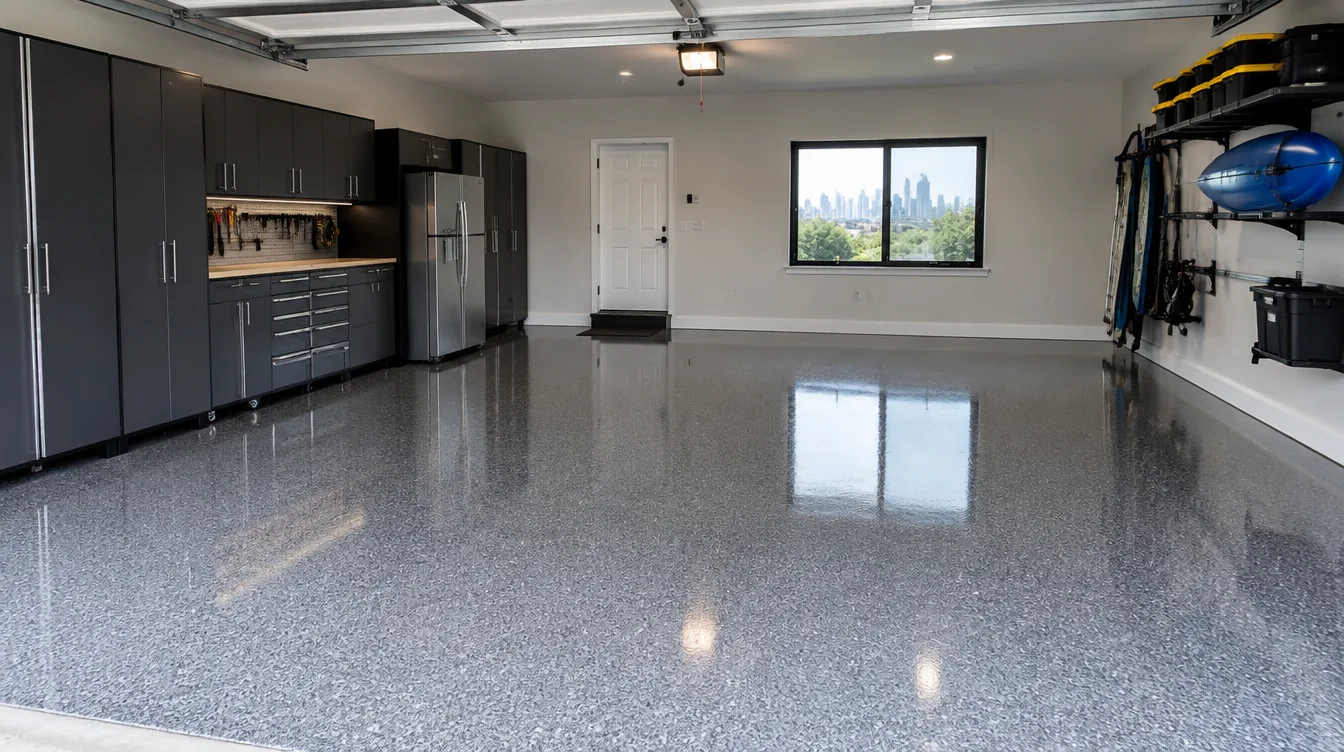
Polyaspartic floor coating cost is one of the first questions Nashville homeowners and business owners ask once they start comparing this premium coating chemistry against standard epoxy. The short answer: expect to pay more per square foot than a basic epoxy system, but the premium reflects real material and labor advantages rather than just a marketing markup.
Below is a full breakdown of what drives 2026 Nashville polyaspartic pricing for both residential and commercial projects, so you can budget accurately and understand exactly what you're paying for when a quote comes in higher than a standard epoxy bid.
Nashville Polyaspartic Cost Ranges
For a typical residential two-car garage, Nashville polyaspartic installations generally run in the $1,800 to $2,600 range, with the final number depending heavily on existing concrete condition, flake density, and the number of topcoat layers specified. A single-car garage runs proportionally less, while larger three-car garages or oversized bays scale up from there.
| Project Type | Typical Nashville Cost Range |
|---|---|
| 1-car garage (residential) | $1,000 - $1,500 |
| 2-car garage (residential) | $1,800 - $2,600 |
| 3-car garage (residential) | $2,600 - $3,800 |
| Commercial (per sq ft) | $6 - $12+ per sq ft |
Commercial polyaspartic pricing is generally quoted per square foot rather than as a flat project price, since commercial floors vary widely in size, substrate condition, and performance requirements. For a full look at how residential garage pricing compares across coating types, see our 2-car garage epoxy cost Nashville breakdown, which walks through standard epoxy pricing for direct comparison.
Why Polyaspartic Costs More Than Standard Epoxy
Two factors drive the polyaspartic premium: material cost and labor efficiency. Polyaspartic resin costs more per gallon than standard epoxy resin due to its more advanced aliphatic chemistry, which is what gives it superior UV stability and a faster cure time in the first place.
Labor pricing reflects the flip side of that same fast cure — polyaspartic's shorter working window means an experienced, efficient crew is essential to apply it correctly before it begins setting up. That expertise commands a premium, but it also delivers real value: many polyaspartic garage floor installations can be completed in a single day, compared to the multi-day cure schedule that standard epoxy often requires before a garage is usable again.
The premium buys three things: faster project turnaround (often one day vs. multiple days for epoxy), better long-term UV stability with less yellowing risk, and generally longer service life before recoating is needed.
Residential vs Commercial Polyaspartic Pricing
Residential and commercial polyaspartic projects are priced differently because they involve fundamentally different scopes of work. A residential garage floor is typically a straightforward single-coat or two-coat system over a relatively small, contained area with minimal existing damage.
Commercial polyaspartic installations, by contrast, often involve significantly more square footage, more demanding surface preparation (grinding out old coatings, crack repair, moisture mitigation), and performance specifications tailored to the specific business — slip resistance for a commercial kitchen, chemical resistance for an auto shop, or specific color coding for a warehouse. These added requirements are why commercial per-square-foot polyaspartic pricing carries a wider range than the relatively predictable residential garage pricing.
Is the Premium Worth It for Nashville Properties
For most Nashville homeowners, the polyaspartic premium is worth it specifically because of Nashville's climate and lifestyle factors. Garages with natural light exposure through windows or a frequently open garage door see real UV exposure over time, and polyaspartic's superior resistance to yellowing keeps a floor looking new years longer than a standard epoxy topcoat exposed to the same conditions.
The faster cure time also matters more than it might seem on paper — a family that depends on garage access daily benefits meaningfully from a floor that can handle light foot traffic the same day rather than being closed off for 48-72 hours during epoxy cure. For commercial properties where downtime translates directly into lost revenue, that same fast-turnaround advantage can outweigh the higher upfront material cost within the first year of use.
Not every project needs the polyaspartic premium, though — a rental property garage or a space with minimal light exposure and low urgency around downtime may be perfectly well served by standard epoxy instead. Get your Nashville polyaspartic estimate and we'll help determine whether the premium chemistry actually pays off for your specific situation, or whether standard epoxy meets your needs at a lower cost.
What Goes Into a Nashville Polyaspartic Quote
A detailed polyaspartic quote should break down more than just a single lump-sum number, and understanding each line item helps you compare bids apples-to-apples rather than just picking the lowest total. Surface preparation is almost always the first line item, and it's also the one that varies most between properties — a garage with an existing coating that needs to be mechanically ground off, or a slab with cracks and moisture issues, will cost more to prep than a clean, bare concrete surface.
- Diamond grinding prep: mechanically profiling the concrete to open the pores for proper adhesion, priced by square footage and existing surface condition.
- Crack and joint repair: filling and repairing any structural cracks before coating, billed separately when significant damage exists.
- Base coat and flake broadcast: the pigmented base layer and decorative flake or quartz broadcast, with denser flake coverage costing more than a light broadcast.
- Topcoat layers: most residential jobs use one to two clear polyaspartic topcoats; commercial floors with heavier traffic sometimes specify additional layers for added wear resistance.
- Optional add-ons: integral cove base, line striping, or slip-resistant additives for commercial kitchens and shops, each priced separately.
Our full polyaspartic floor coating Nashville service page walks through the exact material specifications and process we use on every project, so you know precisely what's included before signing anything. Getting an itemized quote rather than a single flat number is the best way to understand exactly what you're paying for and to compare multiple contractor bids fairly.
Financing, Timing, and Getting the Best Value
Many Nashville contractors, including our team, offer financing options for larger residential and commercial polyaspartic projects, which can make the higher upfront cost more manageable when spread across manageable monthly payments. Asking about financing during the quoting process is worthwhile if the total project cost is a stretch, since it opens up the option of the premium coating without requiring the full amount upfront.
Timing can also affect pricing indirectly — scheduling during a contractor's slower season sometimes results in more competitive pricing or faster availability than during peak spring and summer renovation months, when demand for flooring contractors across Middle Tennessee tends to spike. Getting multiple quotes and asking each contractor to itemize their pricing the way described above remains the single best way to ensure you're getting fair value for a Nashville polyaspartic installation, regardless of when you schedule the work.
It's also worth confirming what warranty terms are included at the quoted price, since a lower bid that skips a meaningful warranty can end up costing more in the long run if the coating fails prematurely. A written warranty covering both material defects and installation workmanship gives homeowners and business owners real protection, and any contractor unwilling to put warranty terms in writing before the job starts is a signal worth taking seriously during the comparison process. Nashville property owners who take the time to compare itemized quotes, confirm warranty terms, and ask about financing options up front consistently end up with both a better installation and a clearer sense of exactly what they paid for.