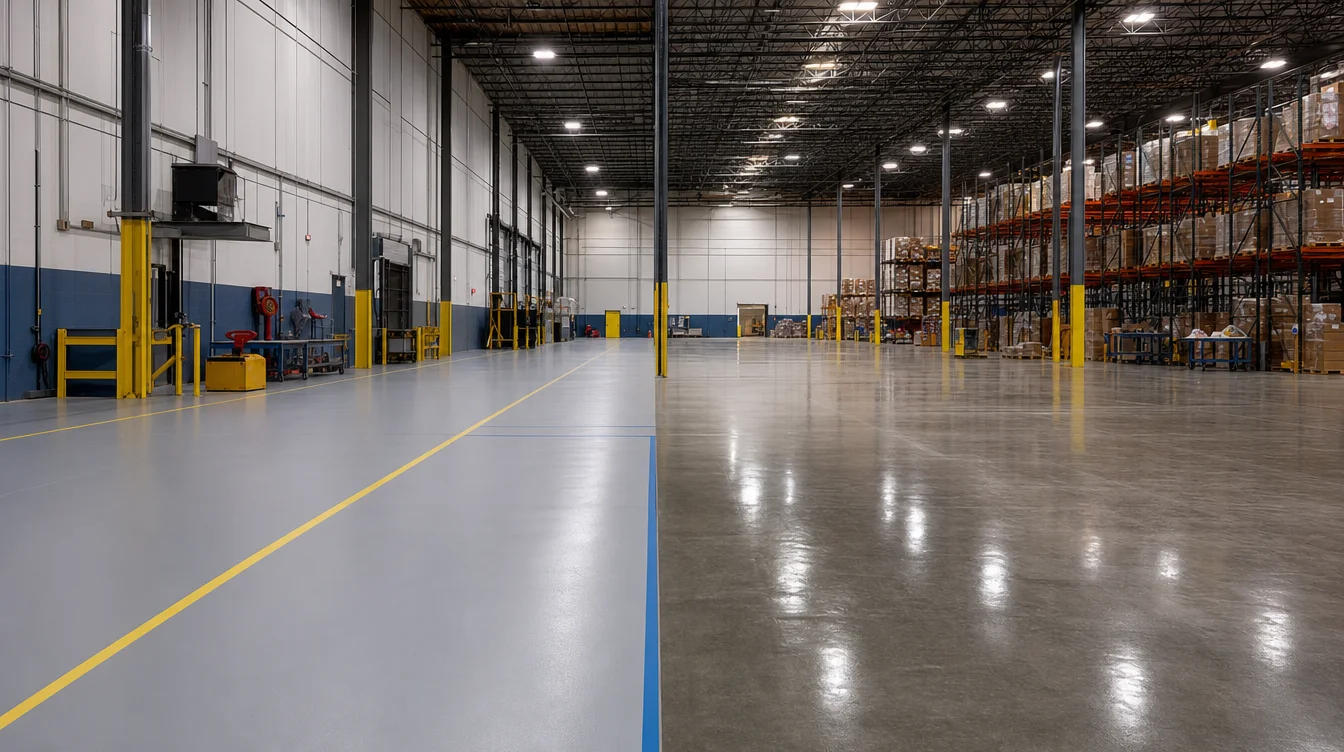
Polished concrete vs epoxy for Nashville warehouses isn't a question with a universal answer - it comes down to what your facility actually does day to day. A distribution center handling forklift traffic and dry goods has very different flooring needs than a manufacturing facility with regular oil, solvent, or chemical exposure. Here's the real tradeoff Nashville warehouse operators should weigh, from Rutherford County's dense logistics corridor to smaller distribution facilities across Davidson County.
Warehouse Floor Requirements in Nashville
Before comparing systems, it helps to define what a warehouse floor actually has to survive:
- Forklift and pallet jack traffic - continuous wheel loading that wears standard flooring faster than foot traffic
- Chemical and fluid exposure - oil, hydraulic fluid, cleaning chemicals, or process chemicals depending on the operation
- Dust control - bare, unsealed concrete generates dust that contaminates inventory and equipment over time
- Long-term durability - warehouse floors need to perform for a decade or more with minimal disruption to operations
Chemical Resistance: Epoxy's Advantage
Epoxy's biggest advantage in warehouse settings is chemical resistance. A properly specified 100% solids epoxy system creates a barrier between the concrete and whatever spills onto it - oils, hydraulic fluid, cleaning chemicals, and most industrial solvents don't penetrate or stain the coating the way they would bare or polished concrete.
Where this matters most: Maintenance bays, loading docks handling fluid-based cargo, and facilities running forklifts or equipment with hydraulic systems all see enough chemical exposure that epoxy's resistance becomes a meaningful operational advantage, not just a nice-to-have.
Longevity and Zero Maintenance: Polished Concrete's Advantage
Polished concrete's advantage is different - it's not a coating that can eventually wear through, chip, or need recoating. Because the durability comes from the densified slab itself, a polished concrete warehouse floor can outlast multiple recoating cycles of an epoxy system, with maintenance limited to routine dust mopping and occasional cleaning.
Which Wins for Your Nashville Warehouse
The decision comes down almost entirely to chemical exposure level:
| Facility Type | Recommended Floor |
|---|---|
| Dry goods / general distribution | Polished concrete - lower long-term maintenance |
| Manufacturing with chemical exposure | Epoxy - chemical and stain resistance |
| Maintenance bays / loading docks | Epoxy - fluid and oil resistance |
| Mixed-use warehouse | Epoxy in high-exposure zones, polished concrete elsewhere |
Many Nashville warehouse operators land on a hybrid approach - epoxy specified only where chemical exposure is real, with polished concrete handling the rest of the floor plan at lower long-term cost. See our concrete polishing Nashville page and warehouse epoxy flooring Nashville page for more on each system, or our commercial floor comparison for the broader picture across all three common commercial floor types.