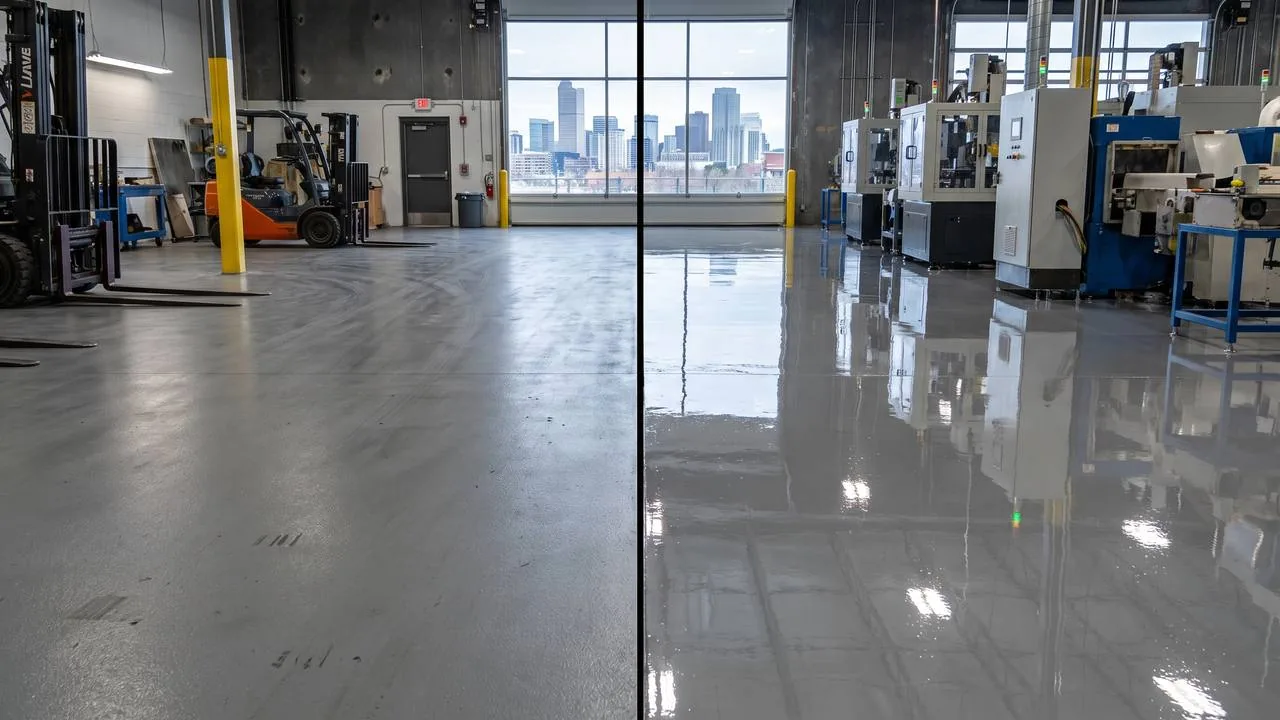
TL;DR: For Nashville garages and homes, polyaspartic wins on UV resistance - which is the decisive factor in Tennessee. But the best system is not one or the other; it is epoxy as the base coat and polyaspartic as the topcoat. Here is exactly why, and when each product makes sense on its own.
What Is Epoxy Floor Coating?
Epoxy is a two-part resin system - a resin and a hardener - that reacts chemically when mixed and forms a rigid, high-build film on the concrete surface. It penetrates the top layer of the slab, creating a mechanical and chemical bond that is dramatically stronger than paint. Standard garage epoxy systems apply at 10–20 mils of thickness, filling minor surface imperfections and creating a smooth, durable base.
Epoxy's strengths: excellent adhesion, high compressive strength, good chemical resistance, and cost-effectiveness as a base layer. Its weakness in Nashville: standard aromatic epoxy topcoats are not UV-stable. Under Tennessee's UV index of 11+, they yellow and chalk within one season, turning what started as a gray or white floor into an amber one.
What Is Polyaspartic Floor Coating?
Polyaspartic is a subcategory of polyurea - a fast-curing, aliphatic (UV-stable) coating that was developed for bridge coatings and industrial applications before the flooring industry adopted it. Unlike aromatic epoxy, aliphatic polyaspartic coatings contain no double-bonded carbon rings that react with UV light, which is why they maintain their color and gloss indefinitely even in direct Tennessee sun.
Polyaspartic also cures significantly faster than epoxy - most formulations reach foot traffic in 4–6 hours and vehicle traffic in 24 hours. It has high flexibility, excellent abrasion resistance, and handles temperature swings well. Its limitation: it is thin (2–4 mils per coat) and does not fill surface defects the way epoxy does. Applied alone over rough or porous concrete, it telegraphs every imperfection.
Head-to-Head Comparison
| Factor | Epoxy | Polyaspartic | Winner |
|---|---|---|---|
| UV Resistance | Yellows in CO sun | Stable, no yellowing | Polyaspartic |
| Build Thickness | 10–20 mils | 2–4 mils per coat | Epoxy |
| Adhesion to Concrete | Excellent (chemical bond) | Good (mechanical bond) | Epoxy |
| Cure Time | 12–24 hrs to walk | 4–6 hrs to walk | Polyaspartic |
| Chemical Resistance | Good | Excellent | Polyaspartic |
| Flexibility | Rigid (can crack with slab) | Semi-flexible | Polyaspartic |
| Surface Filling | Excellent (fills pores) | Poor alone | Epoxy |
| Cost | Lower per coat | Higher per coat | Epoxy |
| Heat Application | Limited above 90°F slab | Better in heat | Polyaspartic |
| Longevity in Nashville | 3–5 yrs (alone) | 10–15 yrs (as top) | Polyaspartic |
Why UV Stability Is the Decisive Factor in Nashville
Nashville receives an average UV Index of 11–12 on summer days - the highest risk category. For context, that is roughly 40% more UV intensity than the national average. Standard aromatic epoxy topcoats contain molecular bonds that react directly with UV radiation, causing a visual yellowing process called photooxidation. A white or light gray epoxy garage floor in Nashville can turn noticeably amber within a single summer.
Nashville UV fact: A floor that looks perfect in April will show visible yellowing by September without a UV-stable topcoat. This is not a quality issue with the epoxy itself - it is chemistry. The solution is always an aliphatic (UV-stable) topcoat, which polyaspartic provides.
Polyaspartic topcoats are aliphatic - their molecular structure does not contain the bonds that react with UV light. Color and gloss stay stable for the life of the coating, which in a properly installed Nashville system is 15–20 years with annual cleaning and a topcoat refresh around year 10.
ProEpoxy's Standard System: The Best of Both
We do not make homeowners choose between epoxy and polyaspartic because the right answer is both - in the right order:
Diamond Grinding + Moisture Test
We profile the concrete surface with diamond grinders to create mechanical adhesion and remove any contamination, then run a calcium chloride MVER test. If moisture is elevated, a vapor-barrier primer goes down before anything else.
Epoxy Base Coat
A 100% solids epoxy base coat bonds chemically to the profiled concrete, filling surface pores and creating a flat, uniform surface. This is where the system gets its thickness, adhesion, and compressive strength.
Decorative Broadcast (Optional)
Vinyl color flakes or metallic pigment are broadcast into the wet epoxy base coat, creating the finished appearance and adding anti-slip texture. Full broadcast (flake floor-to-floor) completely hides the concrete color underneath.
Polyaspartic Topcoat
One or two coats of UV-stable polyaspartic seal the system, lock in the decorative layer, and provide the chemical and abrasion resistance the floor needs for daily use. This is the coat that faces the Tennessee sun - and it is built to handle it indefinitely.
When Epoxy Alone Makes Sense
There are situations where a straight epoxy system without a polyaspartic topcoat is appropriate:
- Interior commercial floors with no UV exposure (warehouses, storage rooms, back-of-house areas)
- Basement floors with no windows and consistent indoor temperatures
- Industrial applications where chemical resistance matters more than color stability and the area is covered by racking
- Budget installs on short-term rental properties where longevity is not the priority
For any floor in a Nashville garage, covered patio, commercial space with windows, or any surface that receives indirect sunlight - a polyaspartic topcoat is not optional.
When Polyaspartic Alone Makes Sense
Pure polyaspartic systems (no epoxy base) have a place too - typically on newer concrete that is already flat, smooth, and free of significant porosity. Some contractors offer "one-day polyaspartic" systems that skip the epoxy base entirely and apply polyaspartic directly to ground concrete. These can work well on new slabs. On older Nashville garages with oil contamination, previous coatings, or significant porosity, skipping the epoxy base risks adhesion failure within 2–3 years.
Watch out for: contractors who offer one-day polyaspartic at very low prices. Ask specifically: "Does this system include an epoxy base coat, or is it polyaspartic only?" Thin-only systems on old concrete are the most common source of peeling floor calls we receive.