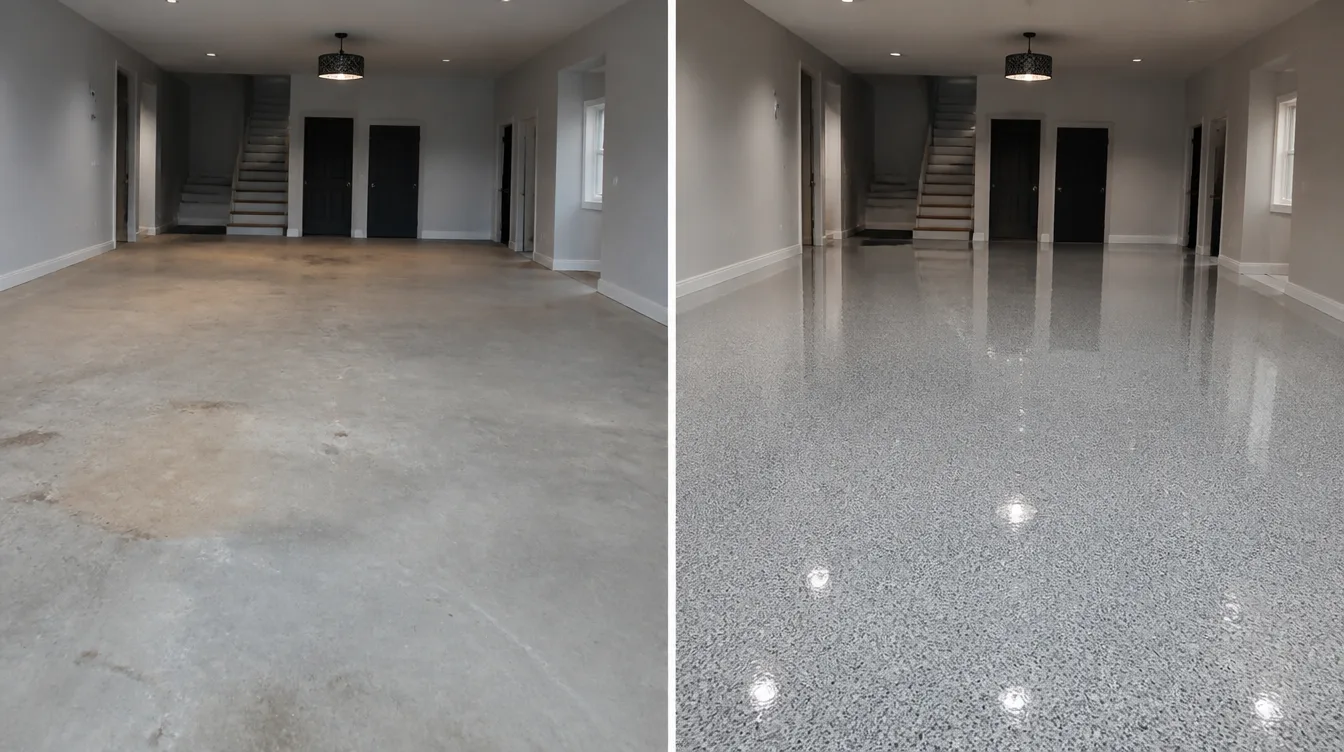
Epoxy flooring ROI is a fair question for any Nashville property owner weighing the upfront cost against the long-term value — and the honest answer is that, done professionally, epoxy flooring genuinely does pay for itself over time, through a combination of avoided maintenance, added resale value, and reduced downtime depending on whether the property is residential or commercial.
Below is a real breakdown of where that ROI actually comes from for both residential and commercial properties, plus a look at the math over a realistic 15-year ownership horizon.
Calculating Epoxy Flooring ROI in Nashville
Calculating epoxy flooring ROI means looking beyond the installation invoice to what a property owner would otherwise spend maintaining, repairing, or eventually replacing an unsealed or poorly maintained concrete floor over the same time period. Bare concrete isn't a maintenance-free surface — it stains, cracks, dusts, and eventually spalls from moisture and freeze-thaw cycling, all of which cost money to address over a property's lifespan.
The ROI calculation, in simple terms, weighs the installation cost against three categories of return: direct cost avoidance (skipped concrete repairs and resurfacing), value contribution (added resale value or lease appeal), and operational benefit (reduced downtime for commercial properties). Is epoxy flooring worth it in Nashville goes deeper into this cost-benefit comparison specifically, but the short version is that most properties see genuine positive returns within the first several years of ownership.
Residential ROI: Resale and Avoided Maintenance
For homeowners, epoxy flooring ROI comes primarily from two sources: contribution to home resale value and avoided ongoing maintenance costs on the underlying concrete. A finished, glossy epoxy garage floor is a visible, tangible upgrade that buyers notice during a showing — it signals a well-maintained home in a way that a stained, cracked bare concrete floor simply doesn't.
On the maintenance side, bare concrete requires periodic sealing, stain treatment, and eventual crack repair to stay presentable, each of which costs money and time over a homeowner's years of ownership. A properly installed epoxy floor eliminates most of that ongoing cost, since the coating itself protects the underlying concrete from the staining, moisture penetration, and surface wear that would otherwise require repeated maintenance.
| Cost Category | Bare Concrete (10 yrs) | Epoxy Floor (10 yrs) |
|---|---|---|
| Sealing/staining maintenance | $400 - $800 | $0 (coating handles this) |
| Crack/spall repair | $300 - $1,200 | Minimal, coating protects surface |
| Resale value contribution | Neutral to negative | Positive, visible upgrade |
Commercial ROI: Downtime, Durability and Tenant Appeal
Commercial ROI works differently, and the numbers can be significantly larger because downtime and repair costs scale with the size and use intensity of the space. A durable epoxy floor in a warehouse, retail space, or light-industrial facility means fewer disruptions for resurfacing or repair — every day a facility is closed or restricted for floor work is a day of lost revenue or productivity that a durable coating avoids in the first place.
Tenant appeal is a real, if less obvious, ROI driver for commercial property owners specifically. A clean, professional, durable floor is a meaningful factor for prospective tenants evaluating retail, warehouse, or light-industrial space, and it can support both faster lease-up and stronger tenant retention compared to a dated or visibly damaged floor. Our commercial epoxy flooring Nashville page covers the specific coating systems and specifications we recommend for different commercial use cases, each with its own durability and ROI profile.
The ROI Math Over 15 Years
Looking at a 15-year ownership horizon makes the ROI case clearest, since it spans enough time for both the avoided-cost and value-contribution sides of the equation to fully play out. For a typical Nashville residential two-car garage, the installation cost is generally offset within 5 to 10 years through a combination of avoided concrete maintenance and the resale value contribution at time of sale, with the remaining years of the coating's service life representing pure additional value.
Commercial properties often see faster payback specifically because downtime costs and repair-avoidance savings can be substantial even within the first few years, particularly for high-traffic facilities where floor-related closures would otherwise be frequent and costly. Over a full 15-year horizon, most epoxy floors — residential or commercial — will have paid for themselves multiple times over relative to the alternative cost of maintaining unsealed or poorly protected concrete for the same period.
The bottom line: epoxy flooring isn't purely a cosmetic upgrade — it's a durability and cost-avoidance investment that, evaluated honestly against the alternative of unprotected concrete, delivers real financial return for both residential and commercial Nashville property owners over a realistic ownership timeline.
Get your Nashville epoxy ROI estimate and we'll walk through the specific numbers for your property, whether it's a residential garage or a commercial facility, so you can see the actual payback timeline rather than a generic estimate.
Factors That Affect Your Specific ROI
Not every property sees identical returns, and several factors meaningfully affect where a given installation falls on the ROI spectrum. Coating quality and installation standards matter enormously — a properly diamond-ground, 100% solids epoxy flooring Nashville installation will deliver years more service life and correspondingly better long-term ROI than a corner-cut installation using acid-etch prep and thinner, lower-solids material, even though the cheaper installation costs less upfront.
Property use intensity is another major factor. A garage used daily for vehicle storage and general activity will see the coating earn its keep faster than a rarely used space, simply because there's more wear and staining being actively prevented. Similarly, a commercial facility with genuinely heavy foot and equipment traffic will realize downtime-avoidance value faster than a lower-traffic office or storage space where floor-related downtime was never a significant risk in the first place.
- Installation quality: proper prep and material specification directly determine how long the coating lasts and how much of the projected ROI actually materializes.
- Usage intensity: higher-traffic spaces realize both maintenance-avoidance and durability value faster than lightly used spaces.
- Local market conditions: Nashville's active real estate market means visible home upgrades like a finished garage floor tend to register more clearly with buyers than in slower markets.
- Timing relative to sale or lease: installing shortly before a home sale or commercial lease-up concentrates the resale/tenant-appeal portion of the ROI into a shorter window.
Property owners who want the clearest possible picture of their own expected ROI should factor in all four of these variables rather than relying on a generic average, since the difference between a well-installed floor on a heavily used property and a corner-cut installation on a lightly used one can be substantial over a full ownership period. A written estimate that breaks down prep method, material specification, and expected service life gives a far more accurate basis for projecting real ROI than a single flat price alone, since two quotes at similar dollar amounts can represent very different underlying installations and, correspondingly, very different long-term returns.
For property owners genuinely comparing epoxy against doing nothing at all, it's worth remembering that bare concrete isn't a neutral, zero-cost baseline — it actively degrades over time through staining, dusting, and moisture-related wear, all of which eventually cost money to address one way or another. Framing the ROI question as epoxy versus an alternative maintenance-free status quo overstates the case for skipping the investment; the more accurate comparison is epoxy versus the real, ongoing cost of maintaining unprotected concrete over the same ownership period.