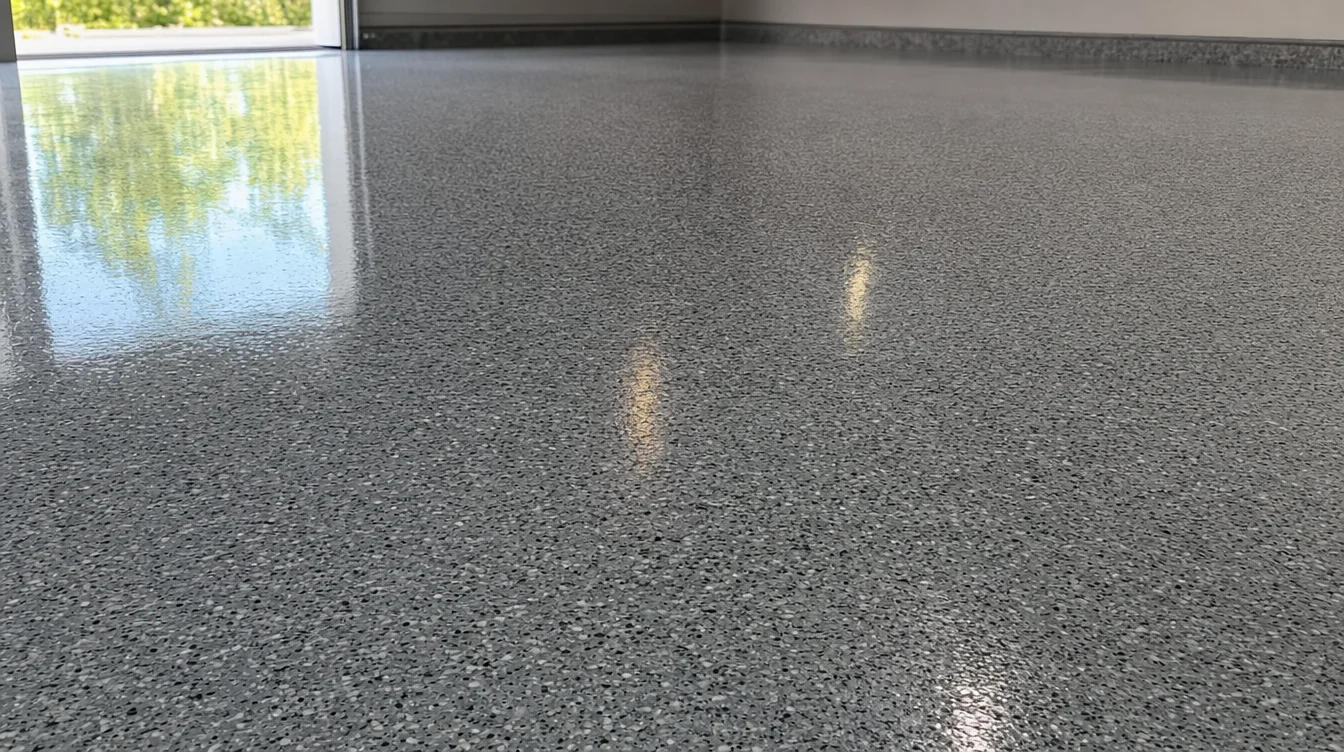
Epoxy flooring myths circulate a lot in Nashville - usually based on outdated information, bad DIY experiences, or a low-quality install that gave the whole category a bad reputation. If you've ruled out epoxy because of something you heard, it's worth checking whether that reason is actually true. Here are the four myths we hear most often, and what's actually accurate.
Myth: Epoxy Flooring Is Too Slippery
This is the myth we hear most, usually from someone picturing a glass-smooth, high-gloss showroom floor. In reality, anti-slip additives can be mixed directly into the topcoat to add meaningful traction without significantly changing the glossy appearance. This is standard practice for entryways, bathrooms, pool decks, and any area where slip resistance matters - it's a specification choice, not a limitation of the material itself.
Myth: Epoxy Always Yellows in Nashville Sunlight
This one has some truth buried in it. Standard epoxy resin is not UV stable and can yellow with sustained sun exposure - but that's exactly why aliphatic polyaspartic topcoats exist. A polyaspartic topcoat over an epoxy base is UV-stable and resists yellowing, even near garage doors or windows that see direct sun for much of the day. The myth applies to bare epoxy with no UV-stable topcoat, not to a properly specified system.
The real issue: Yellowing complaints almost always trace back to a system that skipped the UV-stable topcoat to save cost - not a fundamental limitation of epoxy as a material.
Myth: Epoxy Is Only for Garages
Garages are the most visible and common residential application, which is probably why this myth persists - but epoxy is installed in a much wider range of spaces across Nashville:
Myth: All Epoxy Kits Are the Same as Professional Systems
This is the myth that causes the most disappointment. Big-box DIY epoxy kits and professional 100% solids systems are not the same product, even though they share the word "epoxy" on the label.
| Factor | DIY Kit | Professional System |
|---|---|---|
| Surface prep | Acid etch or light sanding | Diamond grinding |
| Solids content | Often water-based, lower solids | 100% solids, thicker build |
| Moisture testing | Rarely performed | Standard practice |
| Typical lifespan | 1-3 years before peeling/wear | 10+ years with proper care |
The difference isn't marketing - it's surface preparation, material formulation, and testing that a DIY kit simply doesn't include. See our DIY vs professional epoxy Nashville guide for the full comparison, and our epoxy flooring Nashville page for what a professional system actually involves.
One specific issue worth addressing on its own is hot tire pickup - a real coating failure mode, but one that's fully preventable with the right system.