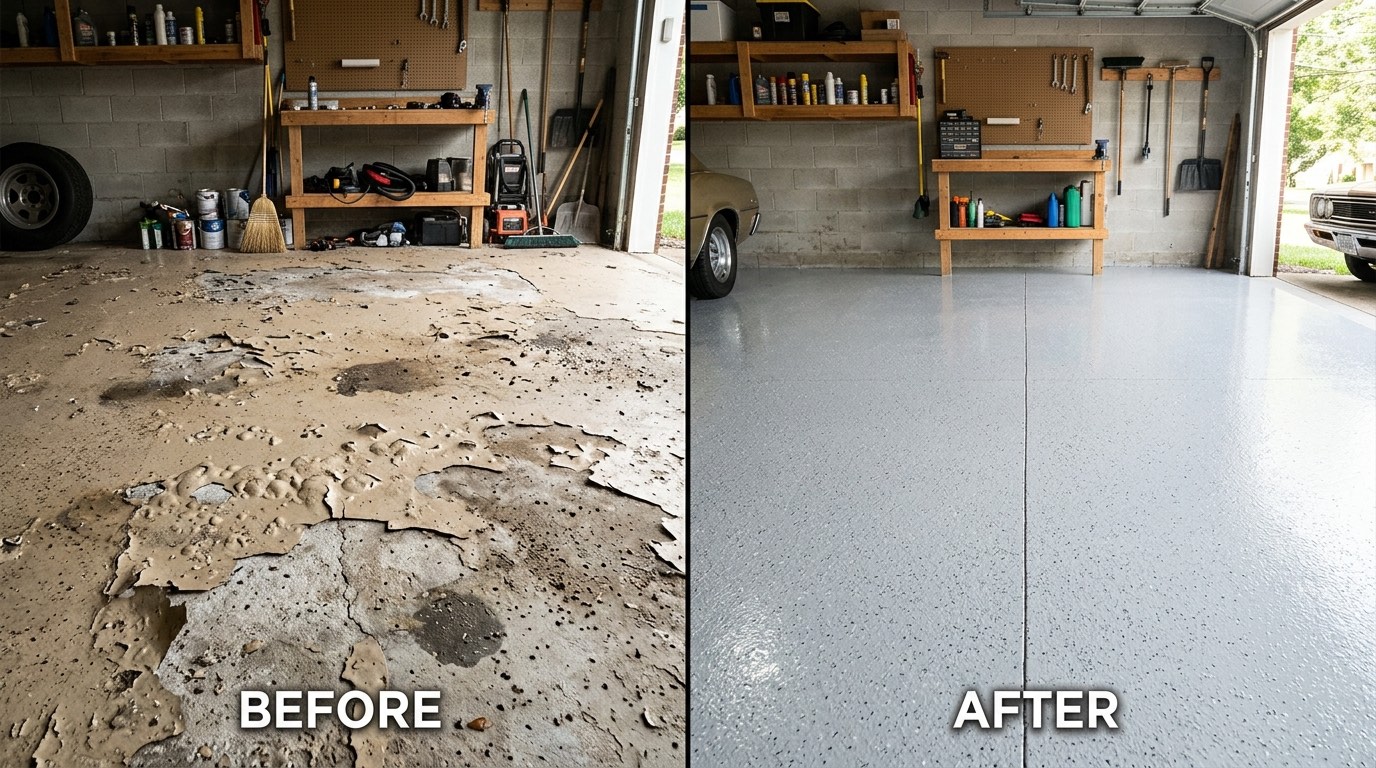
The call we get most often at ProEpoxy Nashville isn't "I want a new epoxy floor." It's "my epoxy floor is peeling - can it be fixed?" The honest answer is: usually yes. But the right fix depends entirely on what caused the failure. Patch the wrong problem with the wrong method and you'll be back where you started in six months. This guide walks through the most common Nashville epoxy floor repair scenarios, what causes each one, and whether spot repair or a full recoat is the right call.
Common Nashville Epoxy Floor Problems: Cracks, Peeling and Bubbling
Nashville garage floors fail in predictable ways. Understanding what you're looking at is the first diagnostic step.
What Causes Epoxy Garage Floors to Peel in Nashville?
Peeling epoxy in Nashville - and across Tennessee broadly - traces back to one root cause in the vast majority of cases: the concrete was not diamond-ground before coating.
Diamond grinding opens the concrete's pore structure to create a mechanical bond with the epoxy. Acid etching alone leaves a smooth surface that looks prepared but lacks the surface profile epoxy needs to grip. Many DIY kits and budget contractors skip grinding because it requires equipment rental or ownership. The result is a coating that adheres just well enough to look fine for one or two years before peeling when exposed to heat, moisture, or vehicle tire pressure.
Nashville humidity note: Middle Tennessee's high summer humidity (averaging 75–80% relative humidity in July) means concrete slabs can hold significant moisture vapor. Applying epoxy over moisture-saturated concrete without a vapor barrier primer traps vapor beneath the coating - creating the blistering failures common in Nashville garage floors.
The second most common cause is moisture vapor transmission. Nashville sits on a limestone karst geology with a high water table in many neighborhoods. Moisture rises through concrete slabs constantly. Without a moisture-tolerant primer designed to block vapor transmission, the epoxy coating eventually delaminates from vapor pressure alone - regardless of how well the surface was prepared.
Crack Repair in Nashville Epoxy Floors: Types and Methods
Not all cracks are equal. A hairline surface crack and a structural crack through the full slab thickness require completely different approaches.
| Crack Type | Appearance | Cause | Repair Method |
|---|---|---|---|
| Hairline surface cracks | Fine lines <1mm wide, no displacement | Concrete shrinkage, minor freeze-thaw | Polyurea injection or flexible epoxy fill, recoat topcoat |
| Control joint cracks | Along pre-cut expansion joints | Normal concrete movement - expected | Flexible polyurea sealant, never rigid epoxy filler |
| Structural cracks | Wide (>3mm), displaced edges, runs full slab thickness | Settlement, soil movement, freeze-thaw over years | Epoxy mortar or polyurethane foam injection; may need slab work before recoat |
| Delamination cracks | Coating surface shows webbing or "map cracking" | Coating failure (not concrete crack) - adhesion loss | Strip old coating, diamond grind, full recoat |
Tennessee's freeze-thaw cycles are a contributing factor in crack widening. Nashville averages 20–30 freeze days per year - enough for water in existing micro-cracks to expand 9% when it freezes, then contract on warming. Over several winters, hairline cracks become visible cracks that admit moisture and compromise epoxy adhesion along their edges.
Repair vs Full Recoat: Which Does Your Nashville Epoxy Floor Need?
The repair-or-recoat decision comes down to the extent of failure and what caused it. If the root cause (bad prep, moisture vapor) isn't addressed, neither a spot repair nor a full recoat will last.
| Condition | Verdict | Why |
|---|---|---|
| Small peeling patch (<10 sq ft), isolated area | Spot Repair | Grind patch, re-prime with moisture barrier, patch epoxy + topcoat |
| Multiple peeling areas scattered across floor | Full Recoat | Widespread adhesion failure indicates prep issue - full strip and redo more cost-effective |
| Bubbling in 1–2 spots | Spot Repair | Patch with moisture-tolerant epoxy after addressing vapor source |
| Bubbling across most of floor | Full Recoat | Systemic moisture vapor issue - needs vapor barrier primer on full surface |
| Hairline cracks only, coating intact elsewhere | Crack Fill | Inject/fill cracks, apply topcoat over affected area |
| Coating over 15 years old, dull/yellowed throughout | Full Recoat | End of coating lifecycle - patching aged epoxy yields poor aesthetic match |
Epoxy Floor Repair Cost Nashville vs Full Replacement
Repair costs scale with scope and whether the root cause (vapor, bad prep) can be addressed without full removal.
| Service | Scope | Nashville Cost Range |
|---|---|---|
| Spot crack fill | 1–5 linear feet of hairline cracks | $150–$350 |
| Patch repair (peeling) | Up to 20 sq ft isolated area | $300–$800 |
| Moisture vapor repair | Full floor - strip, moisture primer, recoat | $1,200–$2,000 |
| Full recoat (2-car garage) | Diamond grind old coating, full epoxy + topcoat | $1,500–$2,500 |
| Full recoat (3-car garage) | Diamond grind, full epoxy system | $2,200–$3,800 |
One important note: a full recoat that includes diamond grinding off the old coating and applying a proper multi-coat epoxy system often costs less than homeowners expect - and significantly less than the regret of a patch that fails again because the original problem wasn't solved.
Nashville Epoxy Floor Repair - Common Questions
Get Your Nashville Epoxy Floor Diagnosed and Repaired
Not sure whether you need a repair or full recoat? ProEpoxy Nashville offers free on-site diagnostics for epoxy floor repair Nashville projects. We inspect the failure, identify the root cause, and give you an honest recommendation - whether that's a $300 patch or a full recoat. We also install new epoxy garage floor Nashville systems and basement epoxy floor Nashville coatings with proper diamond-grind prep and moisture barrier primer as standard. Get your Nashville epoxy floor diagnosed today.