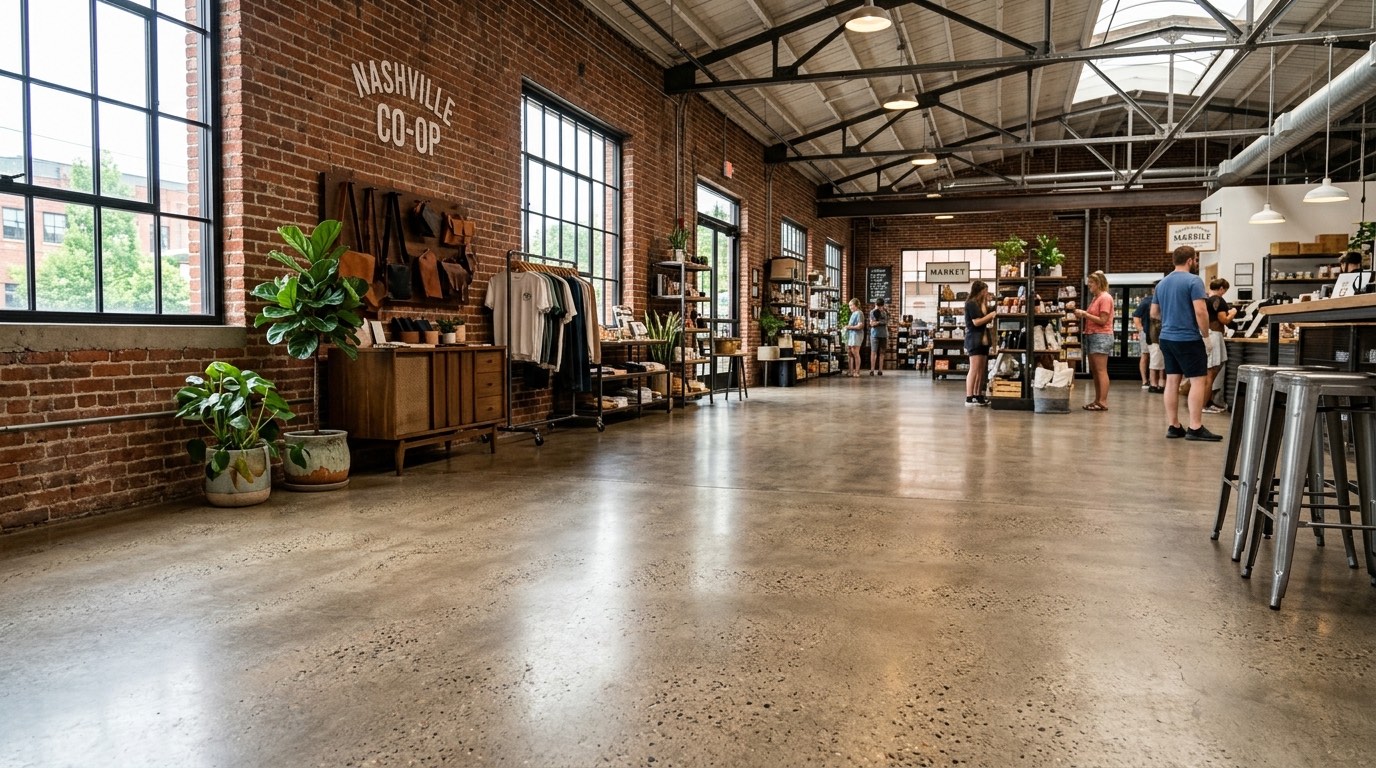
Three concrete floor systems dominate Nashville's residential and commercial renovation market: epoxy coating, polished concrete, and concrete grind and seal. Each has a specific range of applications where it outperforms the other two. Concrete grind and seal Nashville is the system most commonly misunderstood - often described as "the cheaper polished concrete" when it's actually a distinct system with its own ideal applications. This guide clarifies when grind and seal is the right choice for Nashville floors and when it isn't.
What Is Concrete Grind and Seal and Why Nashville Uses It
Concrete grind and seal is a two-stage process. First, diamond grinding wheels cut the concrete surface at relatively low grit levels - typically 50 to 200 grit - to expose the aggregate below the surface paste and create a uniform texture and profile. Then a sealer - penetrating or topical - is applied to protect the ground surface, enhance its appearance, and control dust generation.
It is not the same as epoxy coating (no thick polymer film is applied) and it is not the same as true polished concrete (which uses progressively finer diamond tooling from 30 grit up to 800, 1500, or 3000 grit and applies a densifier rather than a topical sealer). Grind and seal occupies a middle ground: more surface modification than a standard seal, more natural-looking result than an epoxy coating, and less labor-intensive than full mechanical polishing.
Key distinction: Polished concrete uses a densifier that chemically hardens the concrete and requires grinding to 800+ grit. Grind and seal stops at 50–200 grit and applies a sealer on top. The result looks similar at a glance but performs differently - polished concrete is more durable long-term; grind and seal installs faster and costs less.
Concrete Grind and Seal vs Epoxy: 5 Deciding Factors in Nashville
| Factor | Grind & Seal | Epoxy Coating |
|---|---|---|
| Appearance | Natural concrete look - aggregate visible, no film | Solid color or flake - covers concrete character |
| Chemical resistance | Limited - topical sealer degrades with oils/solvents | Strong - 100% solids epoxy resists oils, chemicals |
| Vehicle traffic | Moderate - reseal every 2–3 years under cars | Heavy - epoxy handles daily vehicle use without resealing |
| Patchability | Easy - regrind and reseal patches blend naturally | Harder - color/flake matching required for patches |
| Installed cost | $2–$4/sqft | $4–$8/sqft depending on system |
| Peeling risk | None - no coating to delaminate | Possible if diamond grinding skipped or moisture issue |
| Exterior use | Yes - patios, pool decks, driveways | No - UV degrades standard epoxy; polyaspartic needed |
Concrete Grind and Seal vs Polished Concrete: Key Differences
| Factor | Grind & Seal | Polished Concrete |
|---|---|---|
| Grit level | 50–200 grit final grind | 400–3000 grit final polish |
| Surface treatment | Topical or penetrating sealer | Densifier (chemical hardener) |
| Gloss level | Satin to semi-gloss | High gloss to mirror finish |
| Durability | Good - reseal every 2–3 years | Excellent - no resealing, lasts decades |
| Installed cost Nashville | $2–$6/sqft | $4–$10/sqft |
| Installation time | 1–2 days | 2–4 days (multiple passes) |
For Nashville clients who want the polished concrete look but have a budget constraint or timeline limitation, grind and seal delivers a visually similar result at lower cost. The trade-off is maintenance: a grind and seal floor needs resealing every 2–3 years under normal use, while true concrete polishing Nashville creates a surface that typically requires no periodic resealing.
Best Nashville Applications for Concrete Grind and Seal
Where grind and seal is not the right choice: any Nashville environment with oil drips, chemical spills, or heavy vehicle traffic that creates rubber marks and requires regular degreasing. Those applications need epoxy or polyaspartic. Also not ideal for concrete with significant surface damage - grind and seal exposes aggregate, which means cracks and honeycombing become more visible, not less.
Concrete Grind and Seal Cost in Nashville, TN (2026)
| System | Scope | Nashville Cost / sqft |
|---|---|---|
| Grind + topical sealer | 50–100 grit grind, acrylic or urethane seal | $2–$3 |
| Grind + penetrating sealer | 100–200 grit grind, silane/siloxane seal | $3–$4 |
| Grind + seal + light polish | 200 grit grind, penetrating seal, burnish | $4–$6 |
| Exterior grind and seal | Patio/pool deck, exterior-grade sealer | $3–$5 |
| Resealing existing floor | Clean, light regrind, reseal only | $1–$2 |
Maintenance cost is a factor in the lifetime comparison. Grind and seal floors in Nashville typically need resealing every 2–3 years under moderate use - at $1–2/sqft for a reseal-only visit. Over 10 years, a grind and seal floor in moderate use costs approximately the same as a polished concrete floor installed once without maintenance costs. Under heavy use, the calculus favors polished concrete or epoxy despite the higher upfront cost.
Concrete Grind and Seal Nashville - Common Questions
Get Your Nashville Concrete Grind and Seal Quote
ProEpoxy Nashville installs concrete grind and seal Nashville systems for residential, commercial, and exterior applications. We also install full concrete polishing Nashville systems when the application warrants it, and epoxy garage floor Nashville systems where chemical resistance and durability matter more than natural concrete aesthetics. Get your Nashville concrete grind and seal quote - we'll specify the right system for your floor, use case, and budget before any work begins.