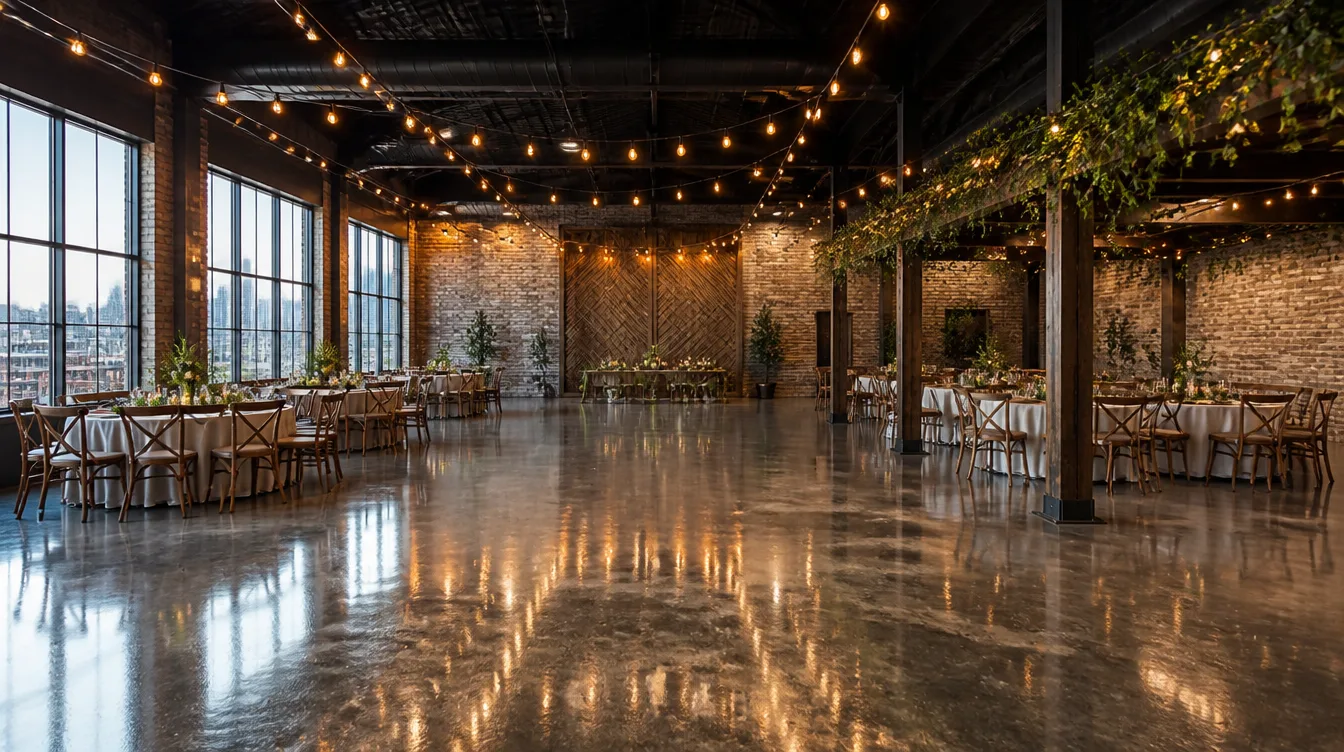
Commercial epoxy flooring for Nashville event venues has to check two boxes that pull in opposite directions for a lot of flooring materials: it needs to survive night after night of hard use — high heels, heavy equipment load-in, alcohol service, chair and table setup — while still photographing beautifully for the weddings, corporate events, and concerts that make up a venue's revenue. Epoxy is one of the few flooring systems that genuinely delivers on both.
Whether you're operating an industrial-chic event space in Wedgewood-Houston or a rooftop venue overlooking downtown Nashville, the flooring underneath every event is doing more work than guests ever notice — until it fails, at which point it becomes the most noticeable thing in the room.
Why Nashville Event Venues Choose Epoxy
Event venues operate on a punishing schedule compared to most commercial spaces — back-to-back bookings, rapid turnovers between events, and a wide variety of activities happening on the same floor within days or even hours of each other. A wedding reception one night might be followed by a corporate product launch the next, each with completely different furniture, equipment, and traffic patterns.
Epoxy's seamless, durable surface handles this variety without showing the accumulated wear that carpet, wood, or even some tile installations develop after a few dozen events. That durability translates directly into fewer flooring-related maintenance disruptions to a venue's booking calendar, which matters enormously for a business where every unbooked date is lost revenue.
High-Heel and Heavy Equipment Durability
Few flooring stress tests are as demanding as a room full of guests in high heels combined with load-in crews moving staging, sound equipment, and furniture across the same surface within the same event. High heels concentrate significant point-load pressure into a tiny surface area, and equipment casters and chair legs add their own scratching and denting risk.
- Scratch-resistant topcoat: a properly cured, quality epoxy topcoat resists the point-load pressure of heels far better than wood or vinyl flooring
- Impact resistance: handles dropped equipment, dollies, and furniture legs without chipping or cracking
- Consistent surface over years of use: unlike wood that can develop soft spots or refinishing needs, a properly maintained epoxy floor holds its performance for 15-20+ years
This durability matters most in venues running multiple events per week, where the cumulative wear of hundreds of events per year would show up quickly on a less durable surface.
Alcohol and Spill Resistance
Alcohol service is standard at the vast majority of event venue bookings, from wedding receptions to corporate happy hours, and spilled wine, beer, and spirits are simply part of the territory. A properly specified epoxy topcoat resists staining and softening from alcohol exposure significantly better than porous flooring materials like unsealed wood or certain tile grouts.
| Flooring Type | Alcohol Spill Resistance | Cleanup Ease |
|---|---|---|
| Hardwood (unsealed/aged) | Low — can stain and warp | Difficult, may require refinishing |
| Carpet | Very low — absorbs and stains | Difficult, often permanent |
| Tile with grout | Moderate — grout stains easily | Moderate |
| Epoxy coating | High | Quick wipe-down |
This resistance isn't just about avoiding permanent stains — it's about turnaround speed. A venue with back-to-back bookings needs to clean and reset between events quickly, and a floor that wipes clean in minutes rather than requiring specialized stain treatment keeps that turnaround realistic.
Aesthetic Flexibility for Branded Events
Beyond pure durability, epoxy offers venues genuine design flexibility that plain concrete or standard commercial flooring can't match. Metallic epoxy finishes in particular create a dramatic, reflective, three-dimensional look that photographs exceptionally well under event lighting — exactly the kind of backdrop that makes a venue's marketing photos and client Instagram posts stand out. See our metallic epoxy flooring Nashville page for the full range of metallic color and pattern options available.
Venues that also host live music or entertainment alongside standard event bookings should also consider the acoustic and durability overlap covered in our guide to Nashville music and entertainment epoxy floors, since many of the same durability and design priorities apply to performance-adjacent spaces.
See our commercial epoxy flooring Nashville page for the full range of durable, design-flexible systems we install for event venues across the metro area.
Managing Turnover Between Back-to-Back Events
One of the most underappreciated advantages of epoxy flooring for event venues is how it affects turnover time between bookings. A venue with events booked on consecutive nights needs to clean, reset, and prep the space quickly, and a seamless, non-porous floor dramatically simplifies that process compared to carpet or a floor with grout lines that trap debris and spills.
Fast turnover isn't just a convenience — it's a revenue driver. Venues that can confidently book events on back-to-back nights without worrying about a floor that needs extended cleaning or spot treatment between events can maximize their booking calendar in a way that a higher-maintenance floor simply doesn't allow. For venues running a high volume of weekend weddings and weekday corporate events, this operational advantage compounds significantly over a full year of bookings.
A practical scheduling note: Installation itself should be planned around your venue's natural slow season or a stretch of open dates, since the coating needs adequate cure time before full event-level traffic and heavy load-in equipment can safely use the space.
How Epoxy Interacts With Event Lighting
Event venues invest heavily in lighting design — string lights, uplighting, spotlights, and often custom setups for individual events — and the floor finish plays a bigger role in how that lighting reads than most venue owners initially expect. A glossy epoxy finish reflects ambient and accent lighting in a way that adds depth and warmth to a room, particularly noticeable in evening events where the floor itself becomes part of the overall lighting design.
Metallic finishes amplify this effect considerably, creating a shimmering, dimensional quality under string lights or uplighting that a flat, matte surface simply can't replicate. This is part of why so many Nashville venues specifically request metallic epoxy for their signature event spaces — it's not just about durability, it's a genuine design element that shows up in every photo taken in the room.
Conversely, venues wanting a more understated, neutral backdrop that lets decor and lighting design take center stage often choose a lower-sheen finish or a subtle flake blend that provides durability without competing visually with the event's own design elements. Either approach works well — the key is deciding intentionally rather than defaulting to whatever finish happens to be cheapest.
Protecting the Floor Investment Long-Term
Given how much revenue an event venue floor supports, protecting that investment with sensible maintenance practices matters as much as the initial specification. A simple daily or between-event dust mop, combined with a neutral pH cleaner for deeper cleaning, keeps the floor performing well without any specialized chemical treatments or resealing schedule.
Venue operators should also establish clear guidelines for vendors and event planners around load-in equipment — dolly wheels, staging feet, and heavy furniture should ideally use floor protection pads during setup and breakdown, a small precaution that meaningfully extends the finish's appearance over years of heavy, repeated use. Most professional event vendors are already accustomed to this kind of floor protection protocol from working in other venues, so it's rarely a difficult ask.
With reasonable care, a properly installed epoxy floor in an event venue setting typically maintains its appearance and performance for well over a decade, representing one of the more durable and cost-effective infrastructure investments a venue owner can make relative to the number of events it will support over that lifespan.