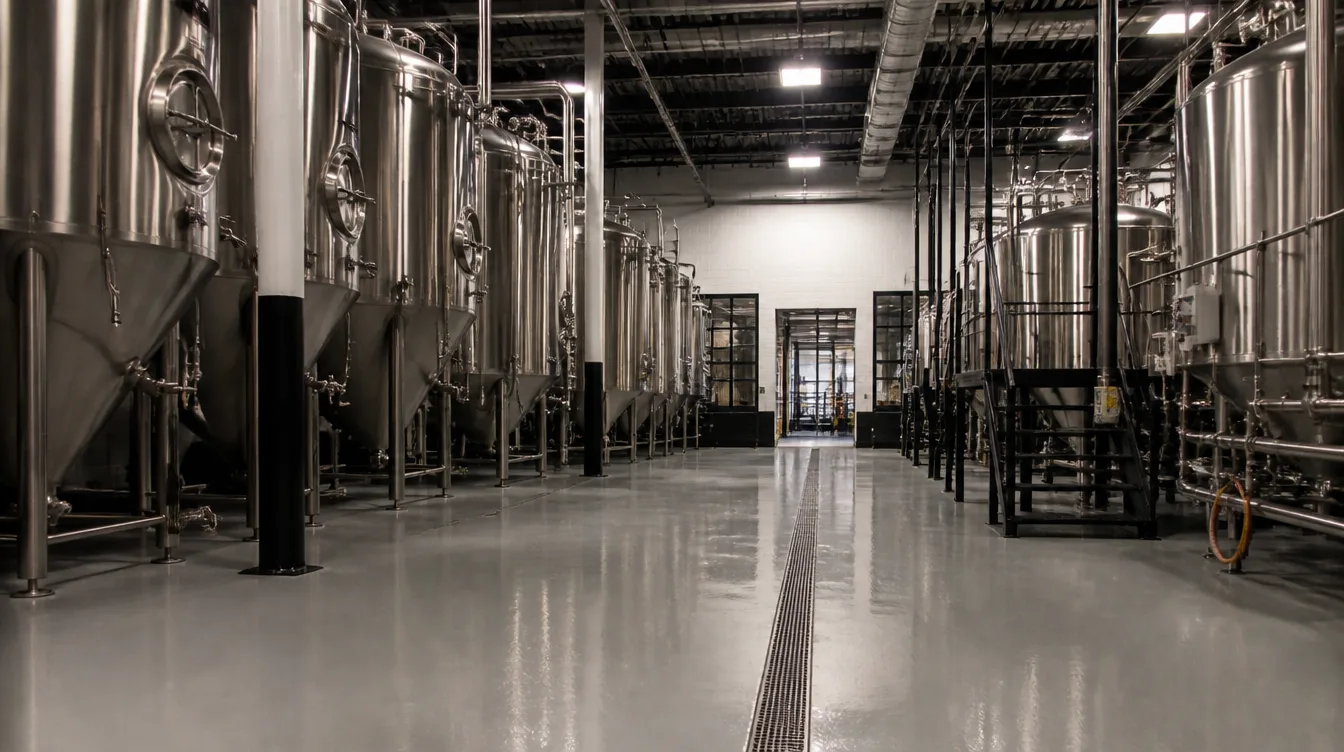
Commercial epoxy flooring for Nashville breweries and distilleries has to solve a problem most other commercial floors never face: near-constant exposure to sugar-rich wort, acidic cleaning chemicals, and hot water wash-down, all on a floor that also has to stay slip-resistant while wet. Standard concrete or a generic coating simply doesn't survive that combination for long, which is why the city's growing craft beverage scene has become one of the more demanding flooring categories ProEpoxy Nashville works in.
If you're planning a new brewhouse, distillery still room, or taproom buildout anywhere from Marathon Village to Wedgewood-Houston, the flooring spec you choose early in the project determines whether you're dealing with a floor that holds up for a decade or one that starts pitting and delaminating within the first year of daily production.
Nashville's Growing Brewery and Distillery Scene
Nashville's craft beer and spirits scene has expanded well beyond a handful of pioneers into a dense cluster of production breweries, distilleries, and hybrid taproom-production spaces. Marathon Village alone hosts multiple distilling operations inside its historic industrial buildings, while East Nashville and Wedgewood-Houston have become home to a steady stream of new brewhouses converting old warehouse and light-industrial space into production floors.
That growth has created a specific kind of flooring demand: these are working production facilities, not just retail spaces with a bar. A taproom floor might only need to look good and clean easily, but the brewhouse or still room behind it needs a floor engineered to survive daily exposure to the actual brewing or distilling process - and increasingly, owners are specifying that from day one rather than retrofitting a failed floor two years into operation.
Many of these buildups also happen inside older brick-and-timber structures with slabs that were never poured with a food-and-beverage production environment in mind. That makes proper substrate preparation and moisture testing just as important as the topcoat chemistry itself - a coating system can only perform as well as the surface it's bonded to.
Chemical Resistance to Wort, Acid and Cleaning Chemicals
The brewing and distilling process exposes floors to a rotating set of aggressive substances: sugar-heavy wort during the boil and fermentation stages, acidic cleaning solutions used to sanitize tanks and lines, caustic (high-pH) cleaners for heavier soil, and in distilleries, occasional exposure to high-proof alcohol itself. Standard epoxy formulations can soften, discolor, or blister under that kind of repeated chemical rotation.
This is where the coating system matters more than it does in almost any other commercial category. Novolac epoxy and vinyl ester epoxy systems are formulated specifically for aggressive chemical exposure and are the standard specification for brewery and distillery production floors, since they resist the acid/caustic cleaning cycle without breaking down the way a general-purpose epoxy would.
- Wort and sugar exposure - daily spillage during brewing and fermentation needs a fully sealed, non-porous surface with no seams for sugar residue to collect in
- Acidic sanitizers - used constantly on tanks, lines, and floors; requires a chemically resistant topcoat rated for repeated low-pH exposure
- Caustic wash-down - high-pH cleaning solutions for heavier soil loads need the same resistant formulation on the caustic end of the spectrum
- Hot water and steam - thermal cycling from hot wash-down water requires a system rated for repeated temperature swings without cracking or delaminating
See our commercial epoxy flooring Nashville page for the full range of chemical-resistant systems we specify for production environments like these.
Slip Resistance for Wet Production Floors
Brewery and distillery production floors are wet almost all the time, whether from active wash-down, condensation off cold tanks, or routine spillage during transfers. A smooth, glossy epoxy finish that looks great in a showroom becomes a serious liability the moment it's consistently wet underfoot.
Production areas need an aggressive aggregate - typically an angular silica or aluminum oxide broadcast - worked into the topcoat to create real mechanical grip, not just a texture that looks slip-resistant on paper. The goal is a coefficient of friction that holds up specifically under wet, soapy conditions, since that's the actual environment the floor sees during every cleaning cycle.
Why this matters for compliance: Slip-and-fall incidents on wet production floors are one of the more common workers' comp claims in food and beverage manufacturing, which makes a properly specified slip-resistant floor as much a safety and liability decision as a durability one.
Taproom vs Production Floor Specifications
One of the most common questions we get from brewery and distillery owners is whether the same flooring system can be used throughout the building. In almost every case, the answer is no - taproom and production areas have genuinely different priorities, and specifying one system for both usually means overpaying in one area and underperforming in the other.
The dividing line usually falls right at the wall separating public-facing space from the working brewhouse or still room, and that's exactly where the flooring spec should change too.
| Area | Primary Requirement | Typical System |
|---|---|---|
| Taproom | Appearance, moderate durability | Decorative flake / metallic epoxy |
| Brewhouse / production | Chemical + slip resistance | Novolac or vinyl ester epoxy, heavy aggregate |
| Still room (distillery) | Chemical resistance, alcohol exposure | Vinyl ester epoxy, sealed seamless system |
| Loading / keg storage | Impact and abrasion resistance | High-build epoxy with aggregate broadcast |
Because many brewery and distillery buildouts also involve serving food, it's worth planning your flooring the same way a commercial kitchen would. Our restaurant epoxy flooring Nashville page covers the same chemical and slip-resistance priorities that apply to any taproom kitchen or food-service add-on.
Facilities running heavier manufacturing-style production alongside their brewing or distilling operation should also look at our guide to commercial epoxy flooring for Nashville manufacturing facilities, since the chemical exposure and heavy-traffic considerations overlap closely with brewhouse production floors.
And if you're weighing epoxy against other commercial flooring categories across different business types, our roundup of industries that rely on epoxy flooring in Nashville breaks down how the spec changes from one industry to the next.
Real-World Flooring Scenarios in Nashville Breweries
A mid-sized production brewery converting a former warehouse in Wedgewood-Houston is a fairly typical project: the existing slab is decades old, has never been exposed to food-and-beverage chemical loads, and needs full moisture testing and crack repair before any coating goes down. In cases like this, skipping substrate prep to save a day of labor is the single most common reason a brewery floor fails early - the topcoat chemistry can be perfect and the floor will still delaminate if the slab underneath wasn't properly prepared and primed.
A distillery still room presents a slightly different scenario. Alcohol vapor and occasional direct spirit exposure add another variable on top of the acid/caustic cleaning cycle, which is why vinyl ester epoxy - rather than a standard novolac system - is often the better call specifically for still rooms and barrel-aging areas, even though it costs somewhat more per square foot than a standard commercial-grade epoxy.
Smaller nano-breweries and taproom-forward operations sometimes try to save money by using one mid-grade epoxy system throughout the entire space. That approach tends to work fine in the taproom itself but shows visible wear within the first year in the brewhouse, where the daily chemical and moisture exposure is simply a different category of demand than a public seating area ever sees. Segmenting the spec by zone - even within a single continuous pour - consistently outperforms a one-size-fits-all approach over the life of the floor.
Existing operators expanding into a second production line or adding a canning area midway through the building's life face their own consideration: matching the new floor's coefficient of friction and chemical resistance to the existing production floor, rather than treating the addition as a cosmetic afterthought. A flooring contractor familiar with brewery and distillery specs specifically - not just general commercial coatings - will typically catch these zone-transition details before they become a maintenance headache down the road.